Go Back
Last Updated :
Last Updated :
Mar 9, 2026
Mar 9, 2026

Form 8801: How to reclaim your prior-year AMT credit
If your startup or e-commerce business has previously been subject to the Alternative Minimum Tax (AMT), you might be sitting on a valuable tax credit—one that can positively impact your current cash flow when claimed correctly. Navigating the AMT credit system doesn’t have to be an operational headache. This guide is designed specifically for founders and finance leaders who want to reclaim their prior-year AMT credit using Form 8801 smartly and efficiently, enhancing cash availability for growth without getting lost in complex tax jargon.
We'll walk you through why Form 8801 matters, how to identify if you qualify, and the step-by-step process to maximize your credit claim. Along the way, you’ll see how this can fit into your broader tax strategy and ultimately strengthen your startup’s financial position.
Who needs to file Form 8801?
Form 8801 isn’t relevant to every startup, but is essential if:
Your company paid AMT in prior years and now owes only regular income tax.
You’re carrying forward AMT credits to future years.
Your company has had differences between the AMT and regular tax due to deductions, income exclusions, or credits.
You make use of other tax incentives like R&D, foreign income exclusions, or electric vehicle credits.
If you are a founder or finance lead managing an aggressive credit strategy, Form 8801 is an important filing in your financial toolkit. Curious about how AMT is calculated? Check out our guide to Form 6251 and AMT calculations.
Breaking down Form 8801: Step-by-step
Use Form 8801 to compute and apply your prior-year AMT credits to the current year’s tax return.
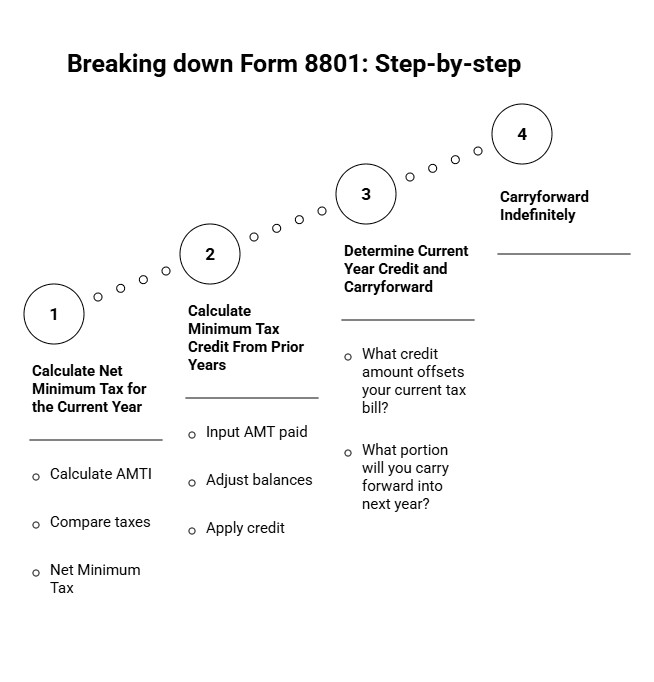
The form has three main parts:
Part I: Calculate Net Minimum Tax for the Current Year
This section reconciles your tentative AMT and your regular tax:
Calculate AMTI: Determine Alternative Minimum Taxable Income by adjusting your taxable income for AMT-specific items.
Compare taxes: Figure out your tentative minimum tax and compare it to your regular tax.
Net Minimum Tax: The excess above regular tax (if any) is the taxable AMT amount, which may increase your credit.
Part II: Calculate Minimum Tax Credit From Prior Years
Here, you report AMT credit carryforwards:
Input AMT paid: Include the AMT amount you paid in earlier years.
Adjust balances: Reflect changes in your income and potential amendments to previous returns.
Apply credit: Your current year’s credit is calculated based on your regular tax liability.
Part III: Determine Current Year Credit and Carryforward
This final section answers:
What credit amount offsets your current tax bill?
What portion will you carry forward into next year?
If credits can’t be fully used this year, the remainder moves forward indefinitely until used.
How Form 8801 interacts with other startup tax positions
Certain credits and exclusions frequently used in startups can affect how your AMT credit is calculated.
R&D Tax Credits
These credits commonly reduce regular tax, but not AMT, resulting in AMT being triggered. If this is the case, you'll likely have AMT credits that can be reclaimed via Form 8801.
Filing Form 8801 in tandem with Form 3800 for general business credits can help optimize how much credit you use.
Foreign Earned Income or Tax Credits
Startups with offshore operations or remote teams may qualify for foreign exclusions or credits that complicate AMT. These benefits may reduce regular tax without reducing AMT, sparking future credits.
Additional IRS worksheets are usually required to reconcile foreign earnings or credits when completing Form 8801.
EV and Green Energy Credits
Certain energy-related credits are excluded for AMT purposes. This can push your AMT above your regular tax, producing credits.
How to use Form 8801 to boost your startup’s cash flow
Think of Form 8801 as a tactical lever for cash efficiency. Filing it can reduce your tax bill, refund unused credits, or even lower next quarter’s tax estimate.
Step 1: Identify AMT credit carryforwards
Review prior-year returns for AMT tax paid. AMT worksheets or tax software reports will help enumerate the carry-forward amounts.
Step 2: File Form 8801 alongside your return
Include Form 8801 in your annual corporate tax filing (currently Form 1120). Timely inclusion ensures prompt processing and avoids missing the opportunity.
Step 3: Reduce future estimated payments
If AMT credits significantly discount your regular tax liability, you may be entitled to reduce quarterly tax estimates accordingly.
Step 4: Roll into a holistic tax strategy
Incorporate AMT credits—and their timing—with broader strategies involving R&D credits, QSBS exemptions, net operating losses, and other founder-relevant deductions.
Explore our services page to understand how integrated accounting workflows can automate this entire process.
Common challenges and how to avoid them
Table: Avoid missteps when filing Form 8801
Challenge | Solution |
Misreporting AMT or credits | Use professional software or consult a startup-specialized accountant |
Filing Form 8801 late or omitting it | Incorporate the form with each year’s return as part of annual planning |
Not coordinating with R&D or foreign tax credits | Use a unified tax strategy that weighs the trade-offs of each benefit |
Losing visibility into carryforward amounts | Track AMT credit balance year-over-year using a working spreadsheet |
IRS regulations and further reading
For the most up-to-date guidance, worksheets, and definitions relating to Form 8801, the IRS provides public-facing instructions:
IRS official Form 8801 instructions
This includes special guidance for estates/trusts, foreign income, energy credits, and handling multiple-year carryforwards.
Form 8801 is an essential tool to reclaim AMT credits and reallocate capital for growth
Running a tax-smart startup includes looking backward—not just forward. If you’ve ever paid AMT, filing Form 8801 may mean unlocking real cash today. That can translate to runway extension, strategic hires, or just lower burn.
AMT was designed to ensure fairness at the IRS — but, ironically, reclaiming those payments also gives founders strategic leverage if they understand tax planning.
To manage AMT and other credits intelligently, without devoting hours to forms and reconciliations, consider a services partner equipped for modern startups.
If your startup or e-commerce business has previously been subject to the Alternative Minimum Tax (AMT), you might be sitting on a valuable tax credit—one that can positively impact your current cash flow when claimed correctly. Navigating the AMT credit system doesn’t have to be an operational headache. This guide is designed specifically for founders and finance leaders who want to reclaim their prior-year AMT credit using Form 8801 smartly and efficiently, enhancing cash availability for growth without getting lost in complex tax jargon.
We'll walk you through why Form 8801 matters, how to identify if you qualify, and the step-by-step process to maximize your credit claim. Along the way, you’ll see how this can fit into your broader tax strategy and ultimately strengthen your startup’s financial position.
Who needs to file Form 8801?
Form 8801 isn’t relevant to every startup, but is essential if:
Your company paid AMT in prior years and now owes only regular income tax.
You’re carrying forward AMT credits to future years.
Your company has had differences between the AMT and regular tax due to deductions, income exclusions, or credits.
You make use of other tax incentives like R&D, foreign income exclusions, or electric vehicle credits.
If you are a founder or finance lead managing an aggressive credit strategy, Form 8801 is an important filing in your financial toolkit. Curious about how AMT is calculated? Check out our guide to Form 6251 and AMT calculations.
Breaking down Form 8801: Step-by-step
Use Form 8801 to compute and apply your prior-year AMT credits to the current year’s tax return.
The form has three main parts:
Part I: Calculate Net Minimum Tax for the Current Year
This section reconciles your tentative AMT and your regular tax:
Calculate AMTI: Determine Alternative Minimum Taxable Income by adjusting your taxable income for AMT-specific items.
Compare taxes: Figure out your tentative minimum tax and compare it to your regular tax.
Net Minimum Tax: The excess above regular tax (if any) is the taxable AMT amount, which may increase your credit.
Part II: Calculate Minimum Tax Credit From Prior Years
Here, you report AMT credit carryforwards:
Input AMT paid: Include the AMT amount you paid in earlier years.
Adjust balances: Reflect changes in your income and potential amendments to previous returns.
Apply credit: Your current year’s credit is calculated based on your regular tax liability.
Part III: Determine Current Year Credit and Carryforward
This final section answers:
What credit amount offsets your current tax bill?
What portion will you carry forward into next year?
If credits can’t be fully used this year, the remainder moves forward indefinitely until used.
How Form 8801 interacts with other startup tax positions
Certain credits and exclusions frequently used in startups can affect how your AMT credit is calculated.
R&D Tax Credits
These credits commonly reduce regular tax, but not AMT, resulting in AMT being triggered. If this is the case, you'll likely have AMT credits that can be reclaimed via Form 8801.
Filing Form 8801 in tandem with Form 3800 for general business credits can help optimize how much credit you use.
Foreign Earned Income or Tax Credits
Startups with offshore operations or remote teams may qualify for foreign exclusions or credits that complicate AMT. These benefits may reduce regular tax without reducing AMT, sparking future credits.
Additional IRS worksheets are usually required to reconcile foreign earnings or credits when completing Form 8801.
EV and Green Energy Credits
Certain energy-related credits are excluded for AMT purposes. This can push your AMT above your regular tax, producing credits.
How to use Form 8801 to boost your startup’s cash flow
Think of Form 8801 as a tactical lever for cash efficiency. Filing it can reduce your tax bill, refund unused credits, or even lower next quarter’s tax estimate.
Step 1: Identify AMT credit carryforwards
Review prior-year returns for AMT tax paid. AMT worksheets or tax software reports will help enumerate the carry-forward amounts.
Step 2: File Form 8801 alongside your return
Include Form 8801 in your annual corporate tax filing (currently Form 1120). Timely inclusion ensures prompt processing and avoids missing the opportunity.
Step 3: Reduce future estimated payments
If AMT credits significantly discount your regular tax liability, you may be entitled to reduce quarterly tax estimates accordingly.
Step 4: Roll into a holistic tax strategy
Incorporate AMT credits—and their timing—with broader strategies involving R&D credits, QSBS exemptions, net operating losses, and other founder-relevant deductions.
Explore our services page to understand how integrated accounting workflows can automate this entire process.
Common challenges and how to avoid them
Table: Avoid missteps when filing Form 8801
Challenge | Solution |
Misreporting AMT or credits | Use professional software or consult a startup-specialized accountant |
Filing Form 8801 late or omitting it | Incorporate the form with each year’s return as part of annual planning |
Not coordinating with R&D or foreign tax credits | Use a unified tax strategy that weighs the trade-offs of each benefit |
Losing visibility into carryforward amounts | Track AMT credit balance year-over-year using a working spreadsheet |
IRS regulations and further reading
For the most up-to-date guidance, worksheets, and definitions relating to Form 8801, the IRS provides public-facing instructions:
IRS official Form 8801 instructions
This includes special guidance for estates/trusts, foreign income, energy credits, and handling multiple-year carryforwards.
Form 8801 is an essential tool to reclaim AMT credits and reallocate capital for growth
Running a tax-smart startup includes looking backward—not just forward. If you’ve ever paid AMT, filing Form 8801 may mean unlocking real cash today. That can translate to runway extension, strategic hires, or just lower burn.
AMT was designed to ensure fairness at the IRS — but, ironically, reclaiming those payments also gives founders strategic leverage if they understand tax planning.
To manage AMT and other credits intelligently, without devoting hours to forms and reconciliations, consider a services partner equipped for modern startups.
This article was co-written by:
Content
This article was co-written by:
2026
© Haven All Rights Reserved
Haven is a financial technology company, not an FDIC-insured bank. Deposit account services are provided by OMB Bank, Member FDIC. Funds deposited into eligible checking and savings accounts are held at OMB Bank and may be eligible for FDIC insurance up to applicable limits. FDIC insurance protects against the failure of an FDIC-insured bank. Certain conditions must be satisfied for pass-through deposit insurance coverage to apply. Fees, terms, and conditions apply.
Cryptocurrency products and services are separate from the deposit account services provided by OMB Bank. Cryptocurrency is not offered, sponsored, endorsed, administered, held, or supported by OMB Bank. Cryptocurrency and other digital assets are not deposits, are not FDIC-insured, are not guaranteed by OMB Bank, and may lose value.
2026
© Haven All Rights Reserved
Haven is a financial technology company, not an FDIC-insured bank. Deposit account services are provided by OMB Bank, Member FDIC. Funds deposited into eligible checking and savings accounts are held at OMB Bank and may be eligible for FDIC insurance up to applicable limits. FDIC insurance protects against the failure of an FDIC-insured bank. Certain conditions must be satisfied for pass-through deposit insurance coverage to apply. Fees, terms, and conditions apply.
Cryptocurrency products and services are separate from the deposit account services provided by OMB Bank. Cryptocurrency is not offered, sponsored, endorsed, administered, held, or supported by OMB Bank. Cryptocurrency and other digital assets are not deposits, are not FDIC-insured, are not guaranteed by OMB Bank, and may lose value.
2026
© Haven All Rights Reserved
Haven is a financial technology company, not an FDIC-insured bank. Deposit account services are provided by OMB Bank, Member FDIC. Funds deposited into eligible checking and savings accounts are held at OMB Bank and may be eligible for FDIC insurance up to applicable limits. FDIC insurance protects against the failure of an FDIC-insured bank. Certain conditions must be satisfied for pass-through deposit insurance coverage to apply. Fees, terms, and conditions apply.
Cryptocurrency products and services are separate from the deposit account services provided by OMB Bank. Cryptocurrency is not offered, sponsored, endorsed, administered, held, or supported by OMB Bank. Cryptocurrency and other digital assets are not deposits, are not FDIC-insured, are not guaranteed by OMB Bank, and may lose value.