Go Back
Last Updated :
Last Updated :
Mar 20, 2026
Mar 20, 2026

Form S-1 Guide: Navigating the Roadmap to Going Public
Taking your company public is the ultimate milestone for many founders, but the gateway to the stock market is paved with rigorous compliance. At the center of this transition is SEC Form S-1, the comprehensive registration statement required for an Initial Public Offering (IPO). This document isn’t just a legal hurdle; it’s your company’s first formal introduction to the public markets, detailing everything from your financial health to your long-term vision.
This guide provides a founder-focused overview of Form S-1, the key sections you must master, and how to prepare for the scrutiny of both the SEC and potential investors.
What is Form S-1 and Why Does It Matter?
Form S-1 is the initial registration form required by the Securities and Exchange Commission (SEC) for any private company aiming to list its shares on a U.S. exchange. Its primary purpose is to provide "full and fair disclosure" to potential investors, ensuring they have all material information needed to make an informed investment decision.
Why Founders Should Care:
The "Quiet Period": Once you file, you enter a "quiet period" where federal laws strictly limit what you can say publicly about your company to avoid "priming" the market.
Liability: Accuracy is paramount. Material misstatements or omissions can lead to severe legal and financial penalties for the company and its leadership.
Investor Transparency: This is where you tell your story—your business model, competitive advantages, and why your company is a worthwhile investment.
Key Sections of Form S-1 Every Founder Should Know
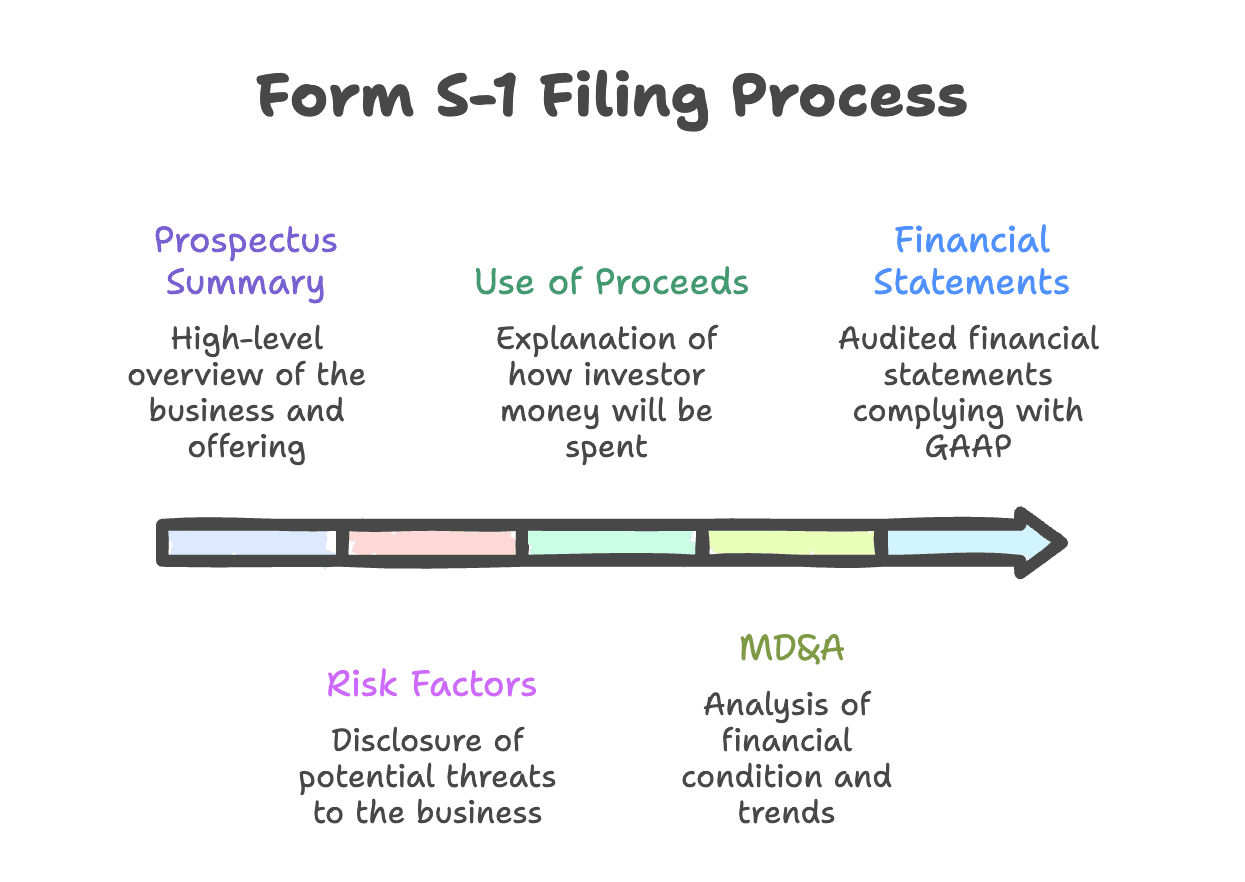
An S-1 filing is a massive undertaking, often hundreds of pages long. It is primarily divided into two parts: the Prospectus (information for investors) and Supplemental Information (information for the SEC).
1. Prospectus Summary
The "elevator pitch" of your S-1. It provides a high-level overview of your business, your market opportunity, and the terms of the offering.
2. Risk Factors
This is arguably the most critical section for legal protection. You must disclose every potential threat to your business, including:
Industry-specific challenges (e.g., regulatory changes).
Reliance on key personnel (including you, the founder).
Cybersecurity risks and competitive pressures.
3. Use of Proceeds
Investors want to know exactly how their money will be spent. Will it go toward R&D, paying off debt, or acquiring new technologies?
4. Management’s Discussion and Analysis (MD&A)
This is where you explain the why behind the numbers. You’ll analyze your financial condition, results of operations, and the key trends driving your performance.
5. Financial Statements
You must provide audited financial statements—typically covering the last two to three fiscal years—that comply with GAAP and are audited by a PCAOB-registered firm.
The Filing Process: From Draft to "Effective"
Filing an S-1 is a marathon, not a sprint. It requires tight coordination between your management team, legal counsel, independent auditors, and investment bankers.
Stage | Action Item |
Preparation | Clean up your cap table and ensure your internal accounting controls are public-company ready. |
Confidential Filing | Many startups file "confidentially" first, allowing them to resolve SEC comments out of the public eye. |
The "Roadshow" | Once the S-1 is public (at least 15 days before the roadshow), you'll pitch to institutional investors. |
Effectiveness | After all SEC comments are addressed, the SEC declares the S-1 "effective," and you can officially sell shares. |
Common Pitfalls to Avoid
Vague Business Descriptions: The SEC hates "boilerplate" language. Be specific about how you make money and your market positioning.
Inconsistent Data: Ensure the numbers in your Business Overview match your Financial Statements and MD&A perfectly.
Underestimating the Timeline: From the first draft to the "ringing of the bell," the process often takes 6 to 12 months.
How to Get Started
Preparation for an IPO starts years before you actually file. Building a foundation of clean, GAAP-compliant books is the first step toward a successful S-1.
Consult Experts Early: Engage with SEC counsel and auditors who specialize in IPOs.
Audit Your Internal Controls: Make sure your financial reporting systems can handle the rigor of public disclosure.
Review Peer S-1s: Look at the filings of recently public companies in your industry to understand common risk factors and narrative structures.
Taking your company public is the ultimate milestone for many founders, but the gateway to the stock market is paved with rigorous compliance. At the center of this transition is SEC Form S-1, the comprehensive registration statement required for an Initial Public Offering (IPO). This document isn’t just a legal hurdle; it’s your company’s first formal introduction to the public markets, detailing everything from your financial health to your long-term vision.
This guide provides a founder-focused overview of Form S-1, the key sections you must master, and how to prepare for the scrutiny of both the SEC and potential investors.
What is Form S-1 and Why Does It Matter?
Form S-1 is the initial registration form required by the Securities and Exchange Commission (SEC) for any private company aiming to list its shares on a U.S. exchange. Its primary purpose is to provide "full and fair disclosure" to potential investors, ensuring they have all material information needed to make an informed investment decision.
Why Founders Should Care:
The "Quiet Period": Once you file, you enter a "quiet period" where federal laws strictly limit what you can say publicly about your company to avoid "priming" the market.
Liability: Accuracy is paramount. Material misstatements or omissions can lead to severe legal and financial penalties for the company and its leadership.
Investor Transparency: This is where you tell your story—your business model, competitive advantages, and why your company is a worthwhile investment.
Key Sections of Form S-1 Every Founder Should Know
An S-1 filing is a massive undertaking, often hundreds of pages long. It is primarily divided into two parts: the Prospectus (information for investors) and Supplemental Information (information for the SEC).
1. Prospectus Summary
The "elevator pitch" of your S-1. It provides a high-level overview of your business, your market opportunity, and the terms of the offering.
2. Risk Factors
This is arguably the most critical section for legal protection. You must disclose every potential threat to your business, including:
Industry-specific challenges (e.g., regulatory changes).
Reliance on key personnel (including you, the founder).
Cybersecurity risks and competitive pressures.
3. Use of Proceeds
Investors want to know exactly how their money will be spent. Will it go toward R&D, paying off debt, or acquiring new technologies?
4. Management’s Discussion and Analysis (MD&A)
This is where you explain the why behind the numbers. You’ll analyze your financial condition, results of operations, and the key trends driving your performance.
5. Financial Statements
You must provide audited financial statements—typically covering the last two to three fiscal years—that comply with GAAP and are audited by a PCAOB-registered firm.
The Filing Process: From Draft to "Effective"
Filing an S-1 is a marathon, not a sprint. It requires tight coordination between your management team, legal counsel, independent auditors, and investment bankers.
Stage | Action Item |
Preparation | Clean up your cap table and ensure your internal accounting controls are public-company ready. |
Confidential Filing | Many startups file "confidentially" first, allowing them to resolve SEC comments out of the public eye. |
The "Roadshow" | Once the S-1 is public (at least 15 days before the roadshow), you'll pitch to institutional investors. |
Effectiveness | After all SEC comments are addressed, the SEC declares the S-1 "effective," and you can officially sell shares. |
Common Pitfalls to Avoid
Vague Business Descriptions: The SEC hates "boilerplate" language. Be specific about how you make money and your market positioning.
Inconsistent Data: Ensure the numbers in your Business Overview match your Financial Statements and MD&A perfectly.
Underestimating the Timeline: From the first draft to the "ringing of the bell," the process often takes 6 to 12 months.
How to Get Started
Preparation for an IPO starts years before you actually file. Building a foundation of clean, GAAP-compliant books is the first step toward a successful S-1.
Consult Experts Early: Engage with SEC counsel and auditors who specialize in IPOs.
Audit Your Internal Controls: Make sure your financial reporting systems can handle the rigor of public disclosure.
Review Peer S-1s: Look at the filings of recently public companies in your industry to understand common risk factors and narrative structures.
This article was co-written by:
Content
This article was co-written by:
2026
© Haven All Rights Reserved
Haven is a financial technology company, not an FDIC-insured bank. Banking services are provided by OMB Bank, Member FDIC. Deposits in checking and savings accounts are held at OMB Bank and are insured by the FDIC up to the applicable limits. FDIC insurance covers the failure of an insured bank. Certain conditions must be met for pass-through insurance coverage to apply. Fees, terms, and conditions apply to depositing and using your account.
2026
© Haven All Rights Reserved
Haven is a financial technology company, not an FDIC-insured bank. Banking services are provided by OMB Bank, Member FDIC. Deposits in checking and savings accounts are held at OMB Bank and are insured by the FDIC up to the applicable limits. FDIC insurance covers the failure of an insured bank. Certain conditions must be met for pass-through insurance coverage to apply. Fees, terms, and conditions apply to depositing and using your account.
2026
© Haven All Rights Reserved
Haven is a financial technology company, not an FDIC-insured bank. Banking services are provided by OMB Bank, Member FDIC. Deposits in checking and savings accounts are held at OMB Bank and are insured by the FDIC up to the applicable limits. FDIC insurance covers the failure of an insured bank. Certain conditions must be met for pass-through insurance coverage to apply. Fees, terms, and conditions apply to depositing and using your account.