Go Back
Last Updated :
Last Updated :
Mar 9, 2026
Mar 9, 2026

Form 1094-C: Master the ACA Transmittal Process to Avoid Costly Employer Mandate Penalties
For startups and growing businesses navigating the complex landscape of healthcare reporting, Form 1094-C is a critical filing that demands your careful attention. Missteps here, especially when combined with employer mandate requirements from the Affordable Care Act (ACA), can trigger penalties that cut into your bottom line—something no founder wants to face.
This comprehensive guide will walk you through mastering the ACA transmittal process with a clear focus on practical steps, timelines, and compliance strategies.
Understanding Form 1094-C and Its Strategic Importance for Employers
Form 1094-C serves as the transmittal summary that accompanies a bundle of Form 1095-C documents submitted annually to the IRS. In simple terms, if your company is an Applicable Large Employer (ALE) — meaning you have 50 or more full-time employees (including full-time equivalents) — completing and filing Form 1094-C is mandatory.
What Form 1094-C Does
Summarizes the health coverage offers you made to your employees across your ALE group(s).
Reports aggregate employee counts and points of contact.
Acts as a cover sheet for the IRS submissions of your Forms 1095-C, which provide detailed info about healthcare offers and enrollment per employee.
This form is critical because it enables the IRS to evaluate your company's compliance with the ACA employer mandate, which requires ALEs to offer affordable, minimum essential health coverage to full-time employees or face penalties.
Why Prioritize Form 1094-C?
Unlike internal bookkeeping, where errors can sometimes be absorbed, Form 1094-C errors invite IRS scrutiny—with penalties that can scale quickly depending on the nature of the mistake and delay. The IRS penalizes late, incomplete, or inaccurate filings with penalty fees that can add up to thousands of dollars or more.
Key Penalties to Keep in Mind
Penalty Type | Description | Amount (2024) |
Late filing | Missing the IRS deadline for submission | $320 per form, capped annually |
Incorrect or missing info | Errors or omissions on forms | $320 per form |
Failure to file altogether | Not submitting required forms | Up to $570 per form depending on duration |
To avoid these, start with a clear understanding of your employer status under ACA rules. For help diving deeper into ACA employer mandates, understand Form 1095-C Reporting for Employers.
Step-by-Step Guide: Mastering the Form 1094-C Filing Process
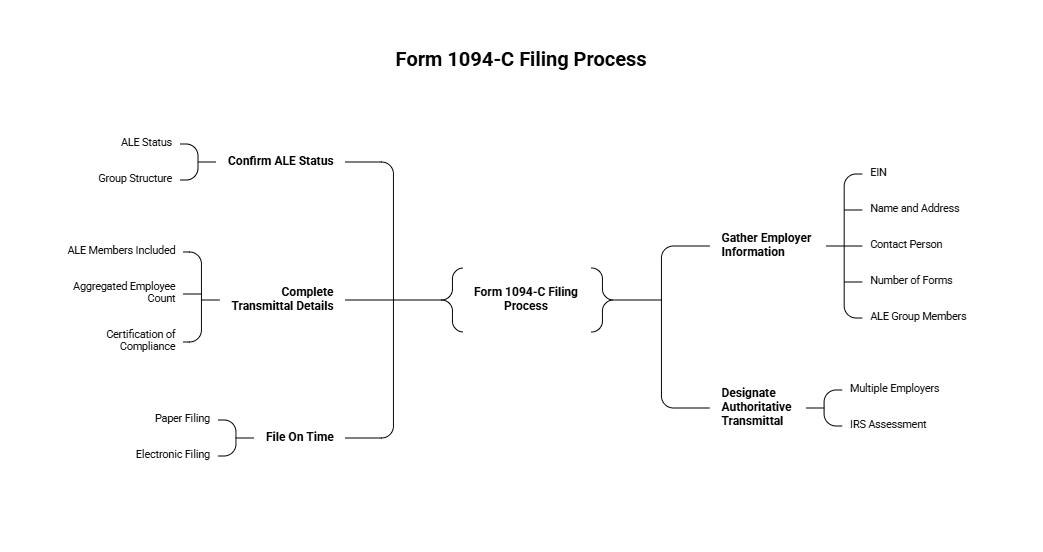
Getting Form 1094-C right requires precision and timing. Here’s how founders and their teams can approach it methodically:
1. Confirm Your ALE Status and Group Structure
Identifying if you are an ALE is the first and non-negotiable step. You become an ALE if your average full-time and full-time equivalent employees during the preceding calendar year were 50 or more. If your business is part of a controlled group of corporations, aggregated counts apply.
Founders must consult both HR and payroll records to accurately calculate headcount—including seasonal shifts.
2. Gather Employer and ALE Group Information
Your Form 1094-C requires:
Employer Identification Number (EIN)
Employer’s name and address
Contact person for ACA reporting questions
Number of Forms 1095-C you are filing
ALE group member identifying information
Many startups overlook the importance of confirming the correct EIN and legal entity names—critical for IRS matching.
3. Complete the Transmittal Details on Form 1094-C
The form includes sections to:
Indicate which ALE members are included in the report
Report the aggregated employee count by month
Provide certification of compliance with ACA requirements
Pay special attention to Lines 22–28, where you report monthly full-time employees, which influence potential penalties.
4. Designate the Authoritative Transmittal
If your ALE group has multiple employers, only one entity can submit the “authoritative” Form 1094-C on behalf of the group. Selecting this entity accurately ensures that the IRS assesses compliance at the correct level.
5. File On Time Through the Correct Channels
Deadlines are strict:
Submission Method | Deadline |
Paper Filing | March 2 (for the prior tax year) |
Electronic Filing | March 31 (required if 250+ forms) |
Electronic filing is mandatory if you submit 250 or more employee forms, which streamlines processing and reduces penalty risk.
Common Pitfalls to Avoid When Filing Form 1094-C
Navigating the process can be complicated by factors that often catch founders off guard:
Mixing up Forms 1094-C and 1095-C: 1094-C is submitted to the IRS, while 1095-C goes to employees.
Missing the Authoritative Transmittal Selection: Forgetting to assign one authoritative ALE member can cause rejection.
Inaccurate Employee Counts: Especially when converting part-time labor into FTEs.
Last-minute submission: Rushing increases human error and risk of delays.
Ignoring corrections: Errors discovered post-submission must be amended quickly, or penalties accrue.
Leveraging Modern Tools for Seamless ACA Reporting
Startups benefit enormously by integrating ACA reporting into payroll and HR systems. Automating the data entry and form generation process can help ensure:
Accurate monthly employee counts
EIN consistency across forms
Deadlines met without manual scrambling
Platforms that sync real-time payroll data with IRS filings reduce risk and free founders to stay focused on driving their business.
If you want tailored support integrating ACA reporting into your finance and HR workflows, explore our startup-aware services here.
How Form 1094-C Compliance Protects Your Startup’s Financial Health
At first glance, Form 1094-C might seem like one of many year-end administrative tasks—but it's actually a frontline defense against costly penalties. Staying compliant keeps cash flow stable, minimizes risk of audits, and ensures you're in good standing when raising funds or preparing for due diligence.
ACA compliance also aligns with other core payroll and regulatory obligations. Clean, accurate filings signal operational maturity to investors, regulators, and future employees.
By taking control of Form 1094-C compliance, your company protects both its runway and its reputation.
Mastering Form 1094-C Is Foundational to ACA Compliance and Avoiding Penalties
In summary, mastering the Form 1094-C transmittal process is not merely a regulatory obligation—it is a strategic imperative for founders who want to sidestep costly employer mandate penalties and maintain clean, confident financial stewardship.
By understanding your ALE status, organizing employee data, carefully completing the form, and filing on time through the appropriate channel, you reduce risk and preserve valuable resources. Embracing modern tools and the right expertise further smooths this process, enabling your startup to focus on what matters most: growth and impact.
Stay proactive about ACA compliance—and let Form 1094-C reporting be one less thing to worry about in your fast-moving startup journey.
For startups and growing businesses navigating the complex landscape of healthcare reporting, Form 1094-C is a critical filing that demands your careful attention. Missteps here, especially when combined with employer mandate requirements from the Affordable Care Act (ACA), can trigger penalties that cut into your bottom line—something no founder wants to face.
This comprehensive guide will walk you through mastering the ACA transmittal process with a clear focus on practical steps, timelines, and compliance strategies.
Understanding Form 1094-C and Its Strategic Importance for Employers
Form 1094-C serves as the transmittal summary that accompanies a bundle of Form 1095-C documents submitted annually to the IRS. In simple terms, if your company is an Applicable Large Employer (ALE) — meaning you have 50 or more full-time employees (including full-time equivalents) — completing and filing Form 1094-C is mandatory.
What Form 1094-C Does
Summarizes the health coverage offers you made to your employees across your ALE group(s).
Reports aggregate employee counts and points of contact.
Acts as a cover sheet for the IRS submissions of your Forms 1095-C, which provide detailed info about healthcare offers and enrollment per employee.
This form is critical because it enables the IRS to evaluate your company's compliance with the ACA employer mandate, which requires ALEs to offer affordable, minimum essential health coverage to full-time employees or face penalties.
Why Prioritize Form 1094-C?
Unlike internal bookkeeping, where errors can sometimes be absorbed, Form 1094-C errors invite IRS scrutiny—with penalties that can scale quickly depending on the nature of the mistake and delay. The IRS penalizes late, incomplete, or inaccurate filings with penalty fees that can add up to thousands of dollars or more.
Key Penalties to Keep in Mind
Penalty Type | Description | Amount (2024) |
Late filing | Missing the IRS deadline for submission | $320 per form, capped annually |
Incorrect or missing info | Errors or omissions on forms | $320 per form |
Failure to file altogether | Not submitting required forms | Up to $570 per form depending on duration |
To avoid these, start with a clear understanding of your employer status under ACA rules. For help diving deeper into ACA employer mandates, understand Form 1095-C Reporting for Employers.
Step-by-Step Guide: Mastering the Form 1094-C Filing Process
Getting Form 1094-C right requires precision and timing. Here’s how founders and their teams can approach it methodically:
1. Confirm Your ALE Status and Group Structure
Identifying if you are an ALE is the first and non-negotiable step. You become an ALE if your average full-time and full-time equivalent employees during the preceding calendar year were 50 or more. If your business is part of a controlled group of corporations, aggregated counts apply.
Founders must consult both HR and payroll records to accurately calculate headcount—including seasonal shifts.
2. Gather Employer and ALE Group Information
Your Form 1094-C requires:
Employer Identification Number (EIN)
Employer’s name and address
Contact person for ACA reporting questions
Number of Forms 1095-C you are filing
ALE group member identifying information
Many startups overlook the importance of confirming the correct EIN and legal entity names—critical for IRS matching.
3. Complete the Transmittal Details on Form 1094-C
The form includes sections to:
Indicate which ALE members are included in the report
Report the aggregated employee count by month
Provide certification of compliance with ACA requirements
Pay special attention to Lines 22–28, where you report monthly full-time employees, which influence potential penalties.
4. Designate the Authoritative Transmittal
If your ALE group has multiple employers, only one entity can submit the “authoritative” Form 1094-C on behalf of the group. Selecting this entity accurately ensures that the IRS assesses compliance at the correct level.
5. File On Time Through the Correct Channels
Deadlines are strict:
Submission Method | Deadline |
Paper Filing | March 2 (for the prior tax year) |
Electronic Filing | March 31 (required if 250+ forms) |
Electronic filing is mandatory if you submit 250 or more employee forms, which streamlines processing and reduces penalty risk.
Common Pitfalls to Avoid When Filing Form 1094-C
Navigating the process can be complicated by factors that often catch founders off guard:
Mixing up Forms 1094-C and 1095-C: 1094-C is submitted to the IRS, while 1095-C goes to employees.
Missing the Authoritative Transmittal Selection: Forgetting to assign one authoritative ALE member can cause rejection.
Inaccurate Employee Counts: Especially when converting part-time labor into FTEs.
Last-minute submission: Rushing increases human error and risk of delays.
Ignoring corrections: Errors discovered post-submission must be amended quickly, or penalties accrue.
Leveraging Modern Tools for Seamless ACA Reporting
Startups benefit enormously by integrating ACA reporting into payroll and HR systems. Automating the data entry and form generation process can help ensure:
Accurate monthly employee counts
EIN consistency across forms
Deadlines met without manual scrambling
Platforms that sync real-time payroll data with IRS filings reduce risk and free founders to stay focused on driving their business.
If you want tailored support integrating ACA reporting into your finance and HR workflows, explore our startup-aware services here.
How Form 1094-C Compliance Protects Your Startup’s Financial Health
At first glance, Form 1094-C might seem like one of many year-end administrative tasks—but it's actually a frontline defense against costly penalties. Staying compliant keeps cash flow stable, minimizes risk of audits, and ensures you're in good standing when raising funds or preparing for due diligence.
ACA compliance also aligns with other core payroll and regulatory obligations. Clean, accurate filings signal operational maturity to investors, regulators, and future employees.
By taking control of Form 1094-C compliance, your company protects both its runway and its reputation.
Mastering Form 1094-C Is Foundational to ACA Compliance and Avoiding Penalties
In summary, mastering the Form 1094-C transmittal process is not merely a regulatory obligation—it is a strategic imperative for founders who want to sidestep costly employer mandate penalties and maintain clean, confident financial stewardship.
By understanding your ALE status, organizing employee data, carefully completing the form, and filing on time through the appropriate channel, you reduce risk and preserve valuable resources. Embracing modern tools and the right expertise further smooths this process, enabling your startup to focus on what matters most: growth and impact.
Stay proactive about ACA compliance—and let Form 1094-C reporting be one less thing to worry about in your fast-moving startup journey.
This article was co-written by:
Content
This article was co-written by:
2026
© Haven All Rights Reserved
Haven is a financial technology company, not an FDIC-insured bank. Deposit account services are provided by OMB Bank, Member FDIC. Funds deposited into eligible checking and savings accounts are held at OMB Bank and may be eligible for FDIC insurance up to applicable limits. FDIC insurance protects against the failure of an FDIC-insured bank. Certain conditions must be satisfied for pass-through deposit insurance coverage to apply. Fees, terms, and conditions apply.
Cryptocurrency products and services are separate from the deposit account services provided by OMB Bank. Cryptocurrency is not offered, sponsored, endorsed, administered, held, or supported by OMB Bank. Cryptocurrency and other digital assets are not deposits, are not FDIC-insured, are not guaranteed by OMB Bank, and may lose value.
2026
© Haven All Rights Reserved
Haven is a financial technology company, not an FDIC-insured bank. Deposit account services are provided by OMB Bank, Member FDIC. Funds deposited into eligible checking and savings accounts are held at OMB Bank and may be eligible for FDIC insurance up to applicable limits. FDIC insurance protects against the failure of an FDIC-insured bank. Certain conditions must be satisfied for pass-through deposit insurance coverage to apply. Fees, terms, and conditions apply.
Cryptocurrency products and services are separate from the deposit account services provided by OMB Bank. Cryptocurrency is not offered, sponsored, endorsed, administered, held, or supported by OMB Bank. Cryptocurrency and other digital assets are not deposits, are not FDIC-insured, are not guaranteed by OMB Bank, and may lose value.
2026
© Haven All Rights Reserved
Haven is a financial technology company, not an FDIC-insured bank. Deposit account services are provided by OMB Bank, Member FDIC. Funds deposited into eligible checking and savings accounts are held at OMB Bank and may be eligible for FDIC insurance up to applicable limits. FDIC insurance protects against the failure of an FDIC-insured bank. Certain conditions must be satisfied for pass-through deposit insurance coverage to apply. Fees, terms, and conditions apply.
Cryptocurrency products and services are separate from the deposit account services provided by OMB Bank. Cryptocurrency is not offered, sponsored, endorsed, administered, held, or supported by OMB Bank. Cryptocurrency and other digital assets are not deposits, are not FDIC-insured, are not guaranteed by OMB Bank, and may lose value.