Go Back
Last Updated :
Last Updated :
Dec 17, 2025
Dec 17, 2025

Choosing the Best Bookkeeping Firm for Your Financial Advisory Practice
As a founder or operations lead running a financial advisory firm, choosing the best bookkeeping firms for financial advisors isn’t just about ticking a box on your business checklist.
Your firm’s success hinges on insightful financial data, timely reporting, and smooth tax filings, all driven by top-notch bookkeeping. This guide breaks down what founders and finance heads should look for when selecting bookkeeping services tailored explicitly for the unique demands of financial advisory businesses.
Why Specialized Bookkeeping Matters for Financial Advisors
Financial advisory firms face distinct regulatory requirements, compliance standards, and financial reporting complexities. Unlike general bookkeeping, specialized bookkeeping for financial advisors aligns accounting processes with key industry nuances such as:
Regulatory compliance (SEC, FINRA)
Client fund management with strict fiduciary standards
Complex revenue recognition related to advisory fees and commissions
Accurate tracking of research and development costs for credits or capitalized expenses
Integrated tax planning and timely filing to optimize returns and avoid penalties
Choosing bookkeeping firms that understand these intricacies saves founders time and operational headaches while strengthening financial transparency for investors and clients alike.
What Makes the Best Bookkeeping Firms for Financial Advisors?
When evaluating bookkeeping providers, financial advisors should prioritize partners that understand the specific operational, regulatory, and reporting demands of advisory businesses. The right bookkeeping firm should go beyond basic accounting and support the financial realities of managing client assets, fees, and compliance.
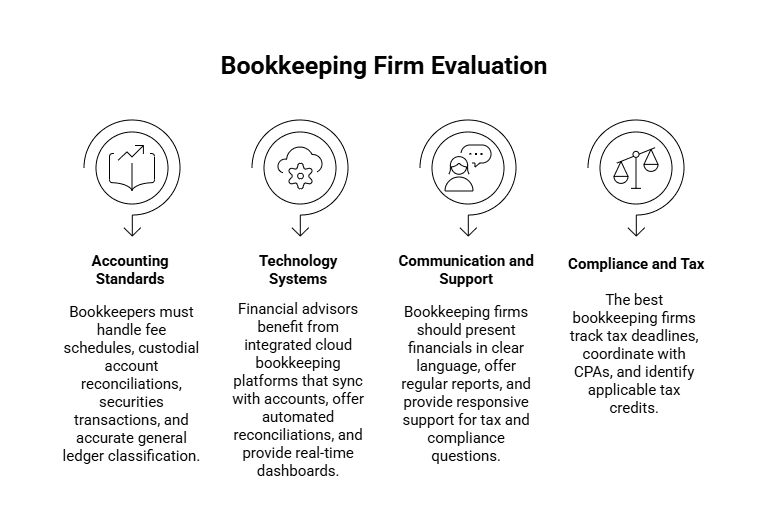
1. Deep Understanding of Financial Advisory Accounting Standards
Bookkeepers must handle:
Fee schedules with tiered, recurring, and performance-based components
Custodial account reconciliations aligned with client fund trust requirements
Securities transactions, including cost basis tracking and wash sales
Accurate general ledger classification for advisory revenues, commissions, and expenses
2. Technology-Forward Systems for Real-Time Visibility
Financial advisors benefit from integrated cloud bookkeeping platforms that:
Sync directly with custodial accounts and bank feeds
Offer automated reconciliations minimizing manual errors
Provide dashboards for real-time P&L, balance sheets, and client profitability
Facilitate quick preparation for audits and financial reviews
3. Founder-Friendly Communication and Support
Bookkeeping firms should present complex financials in clear, jargon-free language with:
Regular financial health reports timed to your business rhythms
Responsive support to answer tax and compliance questions
Advisory insights on optimizing deductions, credits, and cash flow
4. Comprehensive Compliance & Tax Filing Expertise
Given the tight regulatory environment, the best bookkeeping firms:
Track tax deadlines and state-specific filing requirements
Coordinate closely with your CPA or tax advisor for year-end filings
Identify and claim credits such as the R&D tax credit when applicable
Speaking of tax credits, many financial advisory firms invest extensively in R&D to develop proprietary analytics and trading algorithms. Proper bookkeeping can help unlock these R&D tax credits, an often-overlooked treasure for founders. Haven integrates bookkeeping and R&D credit support to maximize returns and minimize audit risk.
Explore Haven’s integrated approach to both bookkeeping services and tax filing to see how you can leverage bookkeeping as a strategic tool—not just an operational necessity.
Choosing Between In-House, Outsourced, and Hybrid Bookkeeping
Financial advisory firms typically evaluate three bookkeeping models: in-house, outsourced, and hybrid. Each option offers a different balance between control, cost, expertise, and scalability — and the right choice depends on firm size, operational complexity, and growth stage.
Below is a brief overview of how each model works in practice, followed by a comparison of pros and cons.
In-House Bookkeeping
In this model, bookkeeping is handled internally by dedicated staff within the advisory firm. It offers maximum control over processes, data access, and day-to-day workflows, but comes with higher fixed costs and ongoing management overhead.
Outsourced Bookkeeping
Outsourced bookkeeping relies on an external firm that specializes in financial advisory accounting. This model prioritizes efficiency, scalability, and access to experienced professionals, making it a strong option for firms that want expert support without building an internal team.
Hybrid Bookkeeping
A hybrid approach combines internal oversight with outsourced expertise. Core financial operations stay in-house, while specialized or high-complexity tasks are handled by external partners. This model works well for firms in transition or scaling their operations.
Model | Pros | Cons | Best for |
In-House | Complete control over data security and process | High overhead; requires expert hires and ongoing training | Large firms with complex workflows |
Outsourced | Cost-effective; access to experts; scalability | Potential communication lags; less direct oversight | Startups, agencies, and firms focused on growth |
Hybrid | Internal control + expert support for advanced tasks | Coordination challenges; workflow inefficiencies | Mid-sized firms expanding operations |
Founders running startups and e-commerce agencies often find outsourcing to a reputable firm like Haven strikes the best balance between cost, expertise, and agility.
How to Evaluate Bookkeeping Pricing for Financial Advisors
Bookkeeping pricing for financial advisors can vary significantly, but the real question isn’t how providers charge — it’s whether the pricing reflects the level of support, accuracy, and advisory-specific expertise your firm needs.
When evaluating bookkeeping costs, financial advisors should focus on value drivers, scope clarity, and long-term fit rather than price alone.
What to Look for When Evaluating Bookkeeping Pricing
1. Scope clarity and inclusions
Before comparing prices, confirm exactly what’s included in each plan. Strong bookkeeping partners clearly define:
Monthly reconciliation coverage (accounts, custodians, entities)
Reporting cadence and level of detail
Support for advisory-specific workflows (AUM-based fees, custodial reconciliations, compliance reporting)
Vague pricing often leads to unexpected add-ons later.
2. Alignment with advisory complexity
Pricing should scale based on transaction volume, number of custodial accounts, reporting complexity, and regulatory needs — not just firm size. A low-cost plan that doesn’t account for advisory-specific requirements can quickly become inefficient or risky.
3. Predictability vs. flexibility
Fixed monthly pricing works well for firms with stable operations and predictable workflows. Hourly or hybrid models may suit firms with fluctuating workloads, but they require tighter oversight to avoid cost creep.
4. Transparency around add-ons and exceptions
Evaluate how providers handle services outside the core scope, such as:
Cleanup or historical corrections
Tax coordination or year-end support
One-off advisory or compliance requests
Clear pricing boundaries signal operational maturity.
Common Pricing Structures (and How to Interpret Them)
Fixed monthly fees offer budgeting predictability, but should be evaluated against service depth and advisory expertise.
Hourly rates provide flexibility, but can introduce variability and require stronger internal tracking.
Tiered packages work best when tiers are tied to meaningful drivers like transaction volume or reporting complexity — not arbitrary thresholds.
A Value-First Perspective on Pricing
For financial advisors, the right bookkeeping pricing model reduces operational risk, improves reporting accuracy, and frees internal time, even if it isn’t the lowest-cost option. Evaluating pricing through this lens helps firms avoid under-scoped solutions that limit growth later.
Maximizing the Benefits of Bookkeeping to Grow Your Advisory Firm
Selecting the best bookkeeping firms for financial advisors is just the beginning. Founders can unlock business value by proactively leveraging bookkeeping outputs:
Cash flow forecasting: anticipate client payment cycles and vendor obligations
Performance analysis: compare profitability across service lines or client segments
Tax planning strategies: identify deductions and credits early in the fiscal year
Compliance readiness: maintain audit trails for SEC or FINRA inquiries
Also, don’t overlook the importance of regularly reviewing your bookkeeping partner’s reports with your CFO or finance team. This habit transforms bookkeeping from a transactional task into a strategic asset.
For those starting the selection process or wanting to understand compliance better, the Small Business Administration (SBA) guide on bookkeeping offers practical insights into record keeping and financial management—a trusted resource to complement your decision.
What Defines the Best Bookkeeping Firms for Growth and Compliance
The best bookkeeping firms for financial advisors aren’t defined by size or brand — they’re defined by how well they support regulatory accuracy, reporting clarity, and scalable operations.
When evaluating bookkeeping firms, financial advisors should look for partners that offer:
Advisory-specific accounting expertise, including fee-based revenue and custodial workflows
Strong tax and compliance coordination, reducing risk and last-minute surprises
Transparent reporting and communication, built for financial decision-making
Flexible, scalable service models that adapt as the firm grows
Firms that meet these criteria are better positioned to support both growth and compliance over time.
As a founder or operations lead running a financial advisory firm, choosing the best bookkeeping firms for financial advisors isn’t just about ticking a box on your business checklist.
Your firm’s success hinges on insightful financial data, timely reporting, and smooth tax filings, all driven by top-notch bookkeeping. This guide breaks down what founders and finance heads should look for when selecting bookkeeping services tailored explicitly for the unique demands of financial advisory businesses.
Why Specialized Bookkeeping Matters for Financial Advisors
Financial advisory firms face distinct regulatory requirements, compliance standards, and financial reporting complexities. Unlike general bookkeeping, specialized bookkeeping for financial advisors aligns accounting processes with key industry nuances such as:
Regulatory compliance (SEC, FINRA)
Client fund management with strict fiduciary standards
Complex revenue recognition related to advisory fees and commissions
Accurate tracking of research and development costs for credits or capitalized expenses
Integrated tax planning and timely filing to optimize returns and avoid penalties
Choosing bookkeeping firms that understand these intricacies saves founders time and operational headaches while strengthening financial transparency for investors and clients alike.
What Makes the Best Bookkeeping Firms for Financial Advisors?
When evaluating bookkeeping providers, financial advisors should prioritize partners that understand the specific operational, regulatory, and reporting demands of advisory businesses. The right bookkeeping firm should go beyond basic accounting and support the financial realities of managing client assets, fees, and compliance.
1. Deep Understanding of Financial Advisory Accounting Standards
Bookkeepers must handle:
Fee schedules with tiered, recurring, and performance-based components
Custodial account reconciliations aligned with client fund trust requirements
Securities transactions, including cost basis tracking and wash sales
Accurate general ledger classification for advisory revenues, commissions, and expenses
2. Technology-Forward Systems for Real-Time Visibility
Financial advisors benefit from integrated cloud bookkeeping platforms that:
Sync directly with custodial accounts and bank feeds
Offer automated reconciliations minimizing manual errors
Provide dashboards for real-time P&L, balance sheets, and client profitability
Facilitate quick preparation for audits and financial reviews
3. Founder-Friendly Communication and Support
Bookkeeping firms should present complex financials in clear, jargon-free language with:
Regular financial health reports timed to your business rhythms
Responsive support to answer tax and compliance questions
Advisory insights on optimizing deductions, credits, and cash flow
4. Comprehensive Compliance & Tax Filing Expertise
Given the tight regulatory environment, the best bookkeeping firms:
Track tax deadlines and state-specific filing requirements
Coordinate closely with your CPA or tax advisor for year-end filings
Identify and claim credits such as the R&D tax credit when applicable
Speaking of tax credits, many financial advisory firms invest extensively in R&D to develop proprietary analytics and trading algorithms. Proper bookkeeping can help unlock these R&D tax credits, an often-overlooked treasure for founders. Haven integrates bookkeeping and R&D credit support to maximize returns and minimize audit risk.
Explore Haven’s integrated approach to both bookkeeping services and tax filing to see how you can leverage bookkeeping as a strategic tool—not just an operational necessity.
Choosing Between In-House, Outsourced, and Hybrid Bookkeeping
Financial advisory firms typically evaluate three bookkeeping models: in-house, outsourced, and hybrid. Each option offers a different balance between control, cost, expertise, and scalability — and the right choice depends on firm size, operational complexity, and growth stage.
Below is a brief overview of how each model works in practice, followed by a comparison of pros and cons.
In-House Bookkeeping
In this model, bookkeeping is handled internally by dedicated staff within the advisory firm. It offers maximum control over processes, data access, and day-to-day workflows, but comes with higher fixed costs and ongoing management overhead.
Outsourced Bookkeeping
Outsourced bookkeeping relies on an external firm that specializes in financial advisory accounting. This model prioritizes efficiency, scalability, and access to experienced professionals, making it a strong option for firms that want expert support without building an internal team.
Hybrid Bookkeeping
A hybrid approach combines internal oversight with outsourced expertise. Core financial operations stay in-house, while specialized or high-complexity tasks are handled by external partners. This model works well for firms in transition or scaling their operations.
Model | Pros | Cons | Best for |
In-House | Complete control over data security and process | High overhead; requires expert hires and ongoing training | Large firms with complex workflows |
Outsourced | Cost-effective; access to experts; scalability | Potential communication lags; less direct oversight | Startups, agencies, and firms focused on growth |
Hybrid | Internal control + expert support for advanced tasks | Coordination challenges; workflow inefficiencies | Mid-sized firms expanding operations |
Founders running startups and e-commerce agencies often find outsourcing to a reputable firm like Haven strikes the best balance between cost, expertise, and agility.
How to Evaluate Bookkeeping Pricing for Financial Advisors
Bookkeeping pricing for financial advisors can vary significantly, but the real question isn’t how providers charge — it’s whether the pricing reflects the level of support, accuracy, and advisory-specific expertise your firm needs.
When evaluating bookkeeping costs, financial advisors should focus on value drivers, scope clarity, and long-term fit rather than price alone.
What to Look for When Evaluating Bookkeeping Pricing
1. Scope clarity and inclusions
Before comparing prices, confirm exactly what’s included in each plan. Strong bookkeeping partners clearly define:
Monthly reconciliation coverage (accounts, custodians, entities)
Reporting cadence and level of detail
Support for advisory-specific workflows (AUM-based fees, custodial reconciliations, compliance reporting)
Vague pricing often leads to unexpected add-ons later.
2. Alignment with advisory complexity
Pricing should scale based on transaction volume, number of custodial accounts, reporting complexity, and regulatory needs — not just firm size. A low-cost plan that doesn’t account for advisory-specific requirements can quickly become inefficient or risky.
3. Predictability vs. flexibility
Fixed monthly pricing works well for firms with stable operations and predictable workflows. Hourly or hybrid models may suit firms with fluctuating workloads, but they require tighter oversight to avoid cost creep.
4. Transparency around add-ons and exceptions
Evaluate how providers handle services outside the core scope, such as:
Cleanup or historical corrections
Tax coordination or year-end support
One-off advisory or compliance requests
Clear pricing boundaries signal operational maturity.
Common Pricing Structures (and How to Interpret Them)
Fixed monthly fees offer budgeting predictability, but should be evaluated against service depth and advisory expertise.
Hourly rates provide flexibility, but can introduce variability and require stronger internal tracking.
Tiered packages work best when tiers are tied to meaningful drivers like transaction volume or reporting complexity — not arbitrary thresholds.
A Value-First Perspective on Pricing
For financial advisors, the right bookkeeping pricing model reduces operational risk, improves reporting accuracy, and frees internal time, even if it isn’t the lowest-cost option. Evaluating pricing through this lens helps firms avoid under-scoped solutions that limit growth later.
Maximizing the Benefits of Bookkeeping to Grow Your Advisory Firm
Selecting the best bookkeeping firms for financial advisors is just the beginning. Founders can unlock business value by proactively leveraging bookkeeping outputs:
Cash flow forecasting: anticipate client payment cycles and vendor obligations
Performance analysis: compare profitability across service lines or client segments
Tax planning strategies: identify deductions and credits early in the fiscal year
Compliance readiness: maintain audit trails for SEC or FINRA inquiries
Also, don’t overlook the importance of regularly reviewing your bookkeeping partner’s reports with your CFO or finance team. This habit transforms bookkeeping from a transactional task into a strategic asset.
For those starting the selection process or wanting to understand compliance better, the Small Business Administration (SBA) guide on bookkeeping offers practical insights into record keeping and financial management—a trusted resource to complement your decision.
What Defines the Best Bookkeeping Firms for Growth and Compliance
The best bookkeeping firms for financial advisors aren’t defined by size or brand — they’re defined by how well they support regulatory accuracy, reporting clarity, and scalable operations.
When evaluating bookkeeping firms, financial advisors should look for partners that offer:
Advisory-specific accounting expertise, including fee-based revenue and custodial workflows
Strong tax and compliance coordination, reducing risk and last-minute surprises
Transparent reporting and communication, built for financial decision-making
Flexible, scalable service models that adapt as the firm grows
Firms that meet these criteria are better positioned to support both growth and compliance over time.
This article was co-written by:
Content
This article was co-written by:
2026
© Haven All Rights Reserved
Haven is a financial technology company, not an FDIC-insured bank. Deposit account services are provided by OMB Bank, Member FDIC. Funds deposited into eligible checking and savings accounts are held at OMB Bank and may be eligible for FDIC insurance up to applicable limits. FDIC insurance protects against the failure of an FDIC-insured bank. Certain conditions must be satisfied for pass-through deposit insurance coverage to apply. Fees, terms, and conditions apply.
Cryptocurrency products and services are separate from the deposit account services provided by OMB Bank. Cryptocurrency is not offered, sponsored, endorsed, administered, held, or supported by OMB Bank. Cryptocurrency and other digital assets are not deposits, are not FDIC-insured, are not guaranteed by OMB Bank, and may lose value.
2026
© Haven All Rights Reserved
Haven is a financial technology company, not an FDIC-insured bank. Deposit account services are provided by OMB Bank, Member FDIC. Funds deposited into eligible checking and savings accounts are held at OMB Bank and may be eligible for FDIC insurance up to applicable limits. FDIC insurance protects against the failure of an FDIC-insured bank. Certain conditions must be satisfied for pass-through deposit insurance coverage to apply. Fees, terms, and conditions apply.
Cryptocurrency products and services are separate from the deposit account services provided by OMB Bank. Cryptocurrency is not offered, sponsored, endorsed, administered, held, or supported by OMB Bank. Cryptocurrency and other digital assets are not deposits, are not FDIC-insured, are not guaranteed by OMB Bank, and may lose value.
2026
© Haven All Rights Reserved
Haven is a financial technology company, not an FDIC-insured bank. Deposit account services are provided by OMB Bank, Member FDIC. Funds deposited into eligible checking and savings accounts are held at OMB Bank and may be eligible for FDIC insurance up to applicable limits. FDIC insurance protects against the failure of an FDIC-insured bank. Certain conditions must be satisfied for pass-through deposit insurance coverage to apply. Fees, terms, and conditions apply.
Cryptocurrency products and services are separate from the deposit account services provided by OMB Bank. Cryptocurrency is not offered, sponsored, endorsed, administered, held, or supported by OMB Bank. Cryptocurrency and other digital assets are not deposits, are not FDIC-insured, are not guaranteed by OMB Bank, and may lose value.