Go Back
Last Updated :
Last Updated :
Dec 1, 2025
Dec 1, 2025

A Founder-Friendly Guide to Bookkeeping for Real Estate Agents
Running a successful real estate business demands more than just closing deals. For real estate agents, bookkeeping for real estate agents is a critical, yet often overlooked, element that can make or break your profitability and compliance. As a founder or operations lead in a fast-paced, client-facing industry, staying on top of your books efficiently ensures you have accurate financial data to make informed decisions and are always ready when tax season arrives.
This comprehensive guide walks you through practical, founder-friendly strategies to simplify bookkeeping tasks, improve your financial processes, and position your real estate business for sustained growth—all while minimizing the stress that often accompanies tax preparation.
Why Bookkeeping for Real Estate Agents Is Different—and How to Get It Right
Real estate agents operate in a unique financial environment that includes commissions, escrow accounts, expense reimbursements, and fluctuating income. Proper bookkeeping is essential not only for clear financial insight but also for compliance with IRS rules, such as tracking 1099 income and deductible expenses accurately.
Key Challenges Unique to Real Estate Bookkeeping
Challenge | Why It Matters | Practical Founder-Friendly Tip |
Commission-Based Income | Income varies widely and payment timing may be irregular. | Use bank feeds and real-time transaction syncing to capture commission deposits promptly. |
Escrow and Trust Funds | Trust accounts must be tracked separately for compliance. | Set up separate accounts in your bookkeeping system to avoid co-mingling funds. |
Deductible Expenses | Expenses from client meetings, marketing, and travel can be deducted but must be documented. | Use digital receipts and mileage tracking apps that integrate with your books. |
1099 Reporting | Agents often receive 1099-MISC/NEC income; proper categorization avoids IRS issues. | Reconcile all 1099 income quarterly and meet with your bookkeeper monthly. |
Understanding these nuances helps you choose the right tools and practices to reduce costly errors and save hours of manual work.
Bookkeeping Tips for Real Estate Agents: Streamline & Simplify
1. Automate Income and Expense Tracking
Automation is the fastest way to simplify bookkeeping:
Integrate bank and payment accounts to automatically import and categorize transactions.
Use accounting software built for service businesses, such as QuickBooks Online or Xero.
Digitize receipts and attach them to transactions for audit-ready documentation.
For a deeper overview of modern approaches, check out Haven’s resource on bookkeeping best practices.
2. Leverage Categorization and Subaccounts
A clear chart of accounts helps separate income and expenses:
Account Type | Recommended Setup |
Income | Buyer Commission, Seller Commission, Referral Fees |
Expenses | Marketing, Client Meetings, Vehicle/Mileage, Office Supplies |
Escrow/Trust | Maintain separate escrow accounts for client funds |
This structure ensures accurate reporting and speeds up tax preparation.
3. Schedule Monthly Financial Reviews
Set a recurring meeting with your bookkeeper or financial lead to:
Review P&L statements
Confirm proper transaction categorization
Track income fluctuations
Prepare for quarterly estimated taxes
These habits reduce tax-time stress and strengthen financial management.
4. Understand Your Tax Obligations as a Real Estate Agent
Real estate agents qualify for multiple deductions, including:
Mileage and vehicle expenses
Marketing and advertising
Office or home workspace
Licensing and MLS fees
The IRS offers clear guidance on documentation requirements in its official section on recordkeeping for small business owners.
For hands-on support, Haven provides tailored solutions through its business tax services.
Modern Bookkeeping Techniques Every Real Estate Agent Should Use
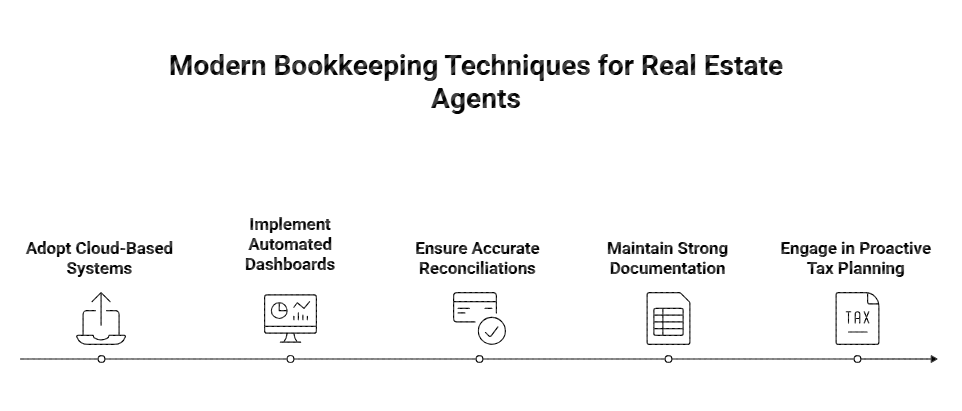
Adopting modern apps and consistent processes provides long-term benefits:
Cloud-based bookkeeping systems for on-the-go access
Automated dashboards for insights by property or time period
Accurate reconciliations to prevent errors and detect fraud
Strong documentation habits to support tax audits
Proactive estimated tax planning based on monthly cash flow
For more strategic insights, explore Haven’s guide to bookkeeping best practices.
The SBA also provides helpful information on common tax obligations in its article on business tax responsibilities.
How Haven Supports Real Estate Founders with Bookkeeping
At Haven, we deliver bookkeeping designed specifically for real estate professionals, including:
Commission and escrow-aware bookkeeping
Integrated banking and payment automation
Monthly reporting and financial check-ins
Tax compliance and optimized refunds
Founder-friendly tools that simplify your day-to-day operations
Learn more about Haven’s offering through our page on bookkeeping services.
Bookkeeping for Real Estate Agents as a Growth Strategy
For real estate agents, bookkeeping for real estate agents is more than a compliance task—it’s a strategic advantage. When you automate your systems, categorize income accurately, and stay proactive with taxes, you gain clearer financial insight and unlock new growth opportunities.
Haven supports real estate founders with expert-backed systems and modern bookkeeping tools that give you confidence in your numbers.
Running a successful real estate business demands more than just closing deals. For real estate agents, bookkeeping for real estate agents is a critical, yet often overlooked, element that can make or break your profitability and compliance. As a founder or operations lead in a fast-paced, client-facing industry, staying on top of your books efficiently ensures you have accurate financial data to make informed decisions and are always ready when tax season arrives.
This comprehensive guide walks you through practical, founder-friendly strategies to simplify bookkeeping tasks, improve your financial processes, and position your real estate business for sustained growth—all while minimizing the stress that often accompanies tax preparation.
Why Bookkeeping for Real Estate Agents Is Different—and How to Get It Right
Real estate agents operate in a unique financial environment that includes commissions, escrow accounts, expense reimbursements, and fluctuating income. Proper bookkeeping is essential not only for clear financial insight but also for compliance with IRS rules, such as tracking 1099 income and deductible expenses accurately.
Key Challenges Unique to Real Estate Bookkeeping
Challenge | Why It Matters | Practical Founder-Friendly Tip |
Commission-Based Income | Income varies widely and payment timing may be irregular. | Use bank feeds and real-time transaction syncing to capture commission deposits promptly. |
Escrow and Trust Funds | Trust accounts must be tracked separately for compliance. | Set up separate accounts in your bookkeeping system to avoid co-mingling funds. |
Deductible Expenses | Expenses from client meetings, marketing, and travel can be deducted but must be documented. | Use digital receipts and mileage tracking apps that integrate with your books. |
1099 Reporting | Agents often receive 1099-MISC/NEC income; proper categorization avoids IRS issues. | Reconcile all 1099 income quarterly and meet with your bookkeeper monthly. |
Understanding these nuances helps you choose the right tools and practices to reduce costly errors and save hours of manual work.
Bookkeeping Tips for Real Estate Agents: Streamline & Simplify
1. Automate Income and Expense Tracking
Automation is the fastest way to simplify bookkeeping:
Integrate bank and payment accounts to automatically import and categorize transactions.
Use accounting software built for service businesses, such as QuickBooks Online or Xero.
Digitize receipts and attach them to transactions for audit-ready documentation.
For a deeper overview of modern approaches, check out Haven’s resource on bookkeeping best practices.
2. Leverage Categorization and Subaccounts
A clear chart of accounts helps separate income and expenses:
Account Type | Recommended Setup |
Income | Buyer Commission, Seller Commission, Referral Fees |
Expenses | Marketing, Client Meetings, Vehicle/Mileage, Office Supplies |
Escrow/Trust | Maintain separate escrow accounts for client funds |
This structure ensures accurate reporting and speeds up tax preparation.
3. Schedule Monthly Financial Reviews
Set a recurring meeting with your bookkeeper or financial lead to:
Review P&L statements
Confirm proper transaction categorization
Track income fluctuations
Prepare for quarterly estimated taxes
These habits reduce tax-time stress and strengthen financial management.
4. Understand Your Tax Obligations as a Real Estate Agent
Real estate agents qualify for multiple deductions, including:
Mileage and vehicle expenses
Marketing and advertising
Office or home workspace
Licensing and MLS fees
The IRS offers clear guidance on documentation requirements in its official section on recordkeeping for small business owners.
For hands-on support, Haven provides tailored solutions through its business tax services.
Modern Bookkeeping Techniques Every Real Estate Agent Should Use
Adopting modern apps and consistent processes provides long-term benefits:
Cloud-based bookkeeping systems for on-the-go access
Automated dashboards for insights by property or time period
Accurate reconciliations to prevent errors and detect fraud
Strong documentation habits to support tax audits
Proactive estimated tax planning based on monthly cash flow
For more strategic insights, explore Haven’s guide to bookkeeping best practices.
The SBA also provides helpful information on common tax obligations in its article on business tax responsibilities.
How Haven Supports Real Estate Founders with Bookkeeping
At Haven, we deliver bookkeeping designed specifically for real estate professionals, including:
Commission and escrow-aware bookkeeping
Integrated banking and payment automation
Monthly reporting and financial check-ins
Tax compliance and optimized refunds
Founder-friendly tools that simplify your day-to-day operations
Learn more about Haven’s offering through our page on bookkeeping services.
Bookkeeping for Real Estate Agents as a Growth Strategy
For real estate agents, bookkeeping for real estate agents is more than a compliance task—it’s a strategic advantage. When you automate your systems, categorize income accurately, and stay proactive with taxes, you gain clearer financial insight and unlock new growth opportunities.
Haven supports real estate founders with expert-backed systems and modern bookkeeping tools that give you confidence in your numbers.
This article was co-written by:
Content
This article was co-written by:
2026
© Haven All Rights Reserved
Haven is a financial technology company, not an FDIC-insured bank. Banking services are provided by OMB Bank, Member FDIC. Deposits in checking and savings accounts are held at OMB Bank and are insured by the FDIC up to the applicable limits. FDIC insurance covers the failure of an insured bank. Certain conditions must be met for pass-through insurance coverage to apply. Fees, terms, and conditions apply to depositing and using your account.
2026
© Haven All Rights Reserved
Haven is a financial technology company, not an FDIC-insured bank. Banking services are provided by OMB Bank, Member FDIC. Deposits in checking and savings accounts are held at OMB Bank and are insured by the FDIC up to the applicable limits. FDIC insurance covers the failure of an insured bank. Certain conditions must be met for pass-through insurance coverage to apply. Fees, terms, and conditions apply to depositing and using your account.
2026
© Haven All Rights Reserved
Haven is a financial technology company, not an FDIC-insured bank. Banking services are provided by OMB Bank, Member FDIC. Deposits in checking and savings accounts are held at OMB Bank and are insured by the FDIC up to the applicable limits. FDIC insurance covers the failure of an insured bank. Certain conditions must be met for pass-through insurance coverage to apply. Fees, terms, and conditions apply to depositing and using your account.