Go Back
Last Updated :
Last Updated :
Jan 19, 2026
Jan 19, 2026
Annual Withheld Federal Income Tax Reporting: A Guide to IRS Form 945
As a founder, managing payroll taxes can feel overwhelming, especially while juggling product development, fundraising, and hiring. One crucial but often overlooked compliance requirement is Form 945, the IRS’s annual return for federal income taxes withheld from wages not covered by traditional payroll forms. Getting this right is key to avoiding penalties and keeping your startup's financials in order.
In this practical guide, we'll break down everything you need to know about Form 945, when it's required, how it compares with other IRS filings, and how to manage compliance efficiently—regardless of whether you're handling payroll internally or working with a provider.
What Is Form 945 and Who Needs to File It?
Form 945, officially titled the Annual Return of Withheld Federal Income Tax, is an IRS form used by businesses to report federal income taxes withheld from certain non-payroll payments.
While most founders are familiar with Form 941 for reporting payroll taxes like Social Security and Medicare, Form 945 is specifically for reporting withheld income tax on payments that don't require payroll tax contributions.
You’ll need to file Form 945 for withheld taxes on:
Pensions and annuities
IRAs and deferred compensation
Military retirement distributions
Gambling winnings
Backup withholding from independent contractors and vendors
If your company only pays traditional wages reported through Form 941, you typically don’t file Form 945. However, if you issue payments that require federal income tax withholding outside of wages—such as payments to vendors subject to backup withholding—you must file Form 945.
Understanding this distinction is crucial. It ensures you're compliant without over-filing or under-reporting.
Form 945 vs. Form 941 and Form 940: What’s the Difference?
Founders often deal with a range of IRS employment tax forms, leaving it unclear where Form 945 fits. Here's a simplified comparison:
Form | Purpose | Frequency | Covers | Common Startup Use Case |
Form 941 | Employer's Quarterly Federal Tax Return | Quarterly | Payroll taxes (wages, Social Security, Medicare, income tax) | Reporting employee wage-related taxes |
Form 940 | Employer’s Annual Federal Unemployment Tax Return | Annually | Federal Unemployment (FUTA) taxes | Reporting employer-only unemployment taxes |
Form 945 | Annual Return of Withheld Federal Income Tax | Annually | Withholding on non-payroll payments | When non-wage payments have withholding requirements |
Need help staying on top of related forms?
For IRS reference, see the official Form 945 instructions.
When Is Form 945 Due and What Are the Filing Requirements?
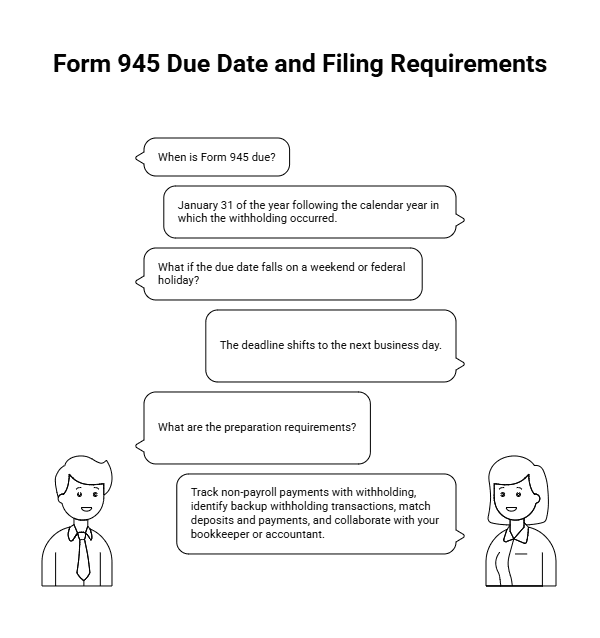
The annual deadline for Form 945 is January 31 of the year following the calendar year in which the withholding occurred.
If the due date falls on a weekend or federal holiday, the deadline shifts to the next business day.
Preparation Checklist
Track all non-payroll payments that include federal income tax withholding.
Identify transactions triggering backup withholding (usually 24%).
Match deposits and payments made to the IRS throughout the year.
Collaborate with your bookkeeper or accountant before January 31 to consolidate totals.
How to Accurately Complete and File IRS Form 945
Accuracy matters—this form reflects a full year of withholding activity.
Key Sections
Tax Return Information: Business name, EIN, address, and year.
Tax Liability: Total federal income tax withheld.
Payment or Refund: Reconcile differences between deposits made and taxes owed.
Signature: Must be signed by an authorized representative.
Filing Methods
Electronically using IRS-approved e-file providers
By mail, depending on your business location
Founders’ Best Practices for Staying IRS-Compliant with Form 945
Form 945 governs the reporting of federal income tax withheld from certain non-payroll payments, including backup withholding. While it’s filed less frequently than payroll forms, errors or missed filings can still create compliance issues.
Below are practical steps founders use to keep Form 945 reporting accurate and low-friction.
1. Automate Backup Withholding
Use accounting or payroll systems that automatically apply withholding when a contractor doesn’t provide a valid taxpayer identification number TIN.
2. Centralize Payroll and Accounting
Integrating systems reduces manual errors and ensures accurate withholding totals. Finding the right software compatibility with your business tax services is key to building a scalable and efficient back-office operation..
3. Calendar Key Deadlines
Form 945 is filed annually, which makes it easier to overlook compared to quarterly payroll forms. Setting recurring calendar reminders—well ahead of the due date—reduces last-minute filings and avoidable penalties.
4. Conduct Year-End Reviews
Before filing, review non-payroll payments made during the year to confirm whether any required backup withholding applies. This includes reviewing contractor payments, settlements, or other reportable transactions.
5. Align Form 945 With Broader Tax Strategy
Consistent and accurate withholding filings support more than just compliance. Clean reporting reduces friction during audits, supports diligence requests during fundraising, and strengthens long-term financial planning.
Founders often review Form 945 alongside related employment tax filings, such as Form 941, to ensure consistency across their overall tax posture.
Where to Find Help Filing Form 945
For founders seeking support with IRS compliance, Haven provides:
End-to-end tax filing assistance
Automations to track contractor and prize-related withholding
Audit-ready documentation
A Smarter Way to Handle Form 945
Startup founders wear many hats—including tax compliance manager. Having a system for Form 945 ensures accurate reporting, prevents penalties, and supports year-end planning.
With clear processes, integrated systems, and expert support, you’ll stay ahead of IRS requirements and avoid January panic.
As a founder, managing payroll taxes can feel overwhelming, especially while juggling product development, fundraising, and hiring. One crucial but often overlooked compliance requirement is Form 945, the IRS’s annual return for federal income taxes withheld from wages not covered by traditional payroll forms. Getting this right is key to avoiding penalties and keeping your startup's financials in order.
In this practical guide, we'll break down everything you need to know about Form 945, when it's required, how it compares with other IRS filings, and how to manage compliance efficiently—regardless of whether you're handling payroll internally or working with a provider.
What Is Form 945 and Who Needs to File It?
Form 945, officially titled the Annual Return of Withheld Federal Income Tax, is an IRS form used by businesses to report federal income taxes withheld from certain non-payroll payments.
While most founders are familiar with Form 941 for reporting payroll taxes like Social Security and Medicare, Form 945 is specifically for reporting withheld income tax on payments that don't require payroll tax contributions.
You’ll need to file Form 945 for withheld taxes on:
Pensions and annuities
IRAs and deferred compensation
Military retirement distributions
Gambling winnings
Backup withholding from independent contractors and vendors
If your company only pays traditional wages reported through Form 941, you typically don’t file Form 945. However, if you issue payments that require federal income tax withholding outside of wages—such as payments to vendors subject to backup withholding—you must file Form 945.
Understanding this distinction is crucial. It ensures you're compliant without over-filing or under-reporting.
Form 945 vs. Form 941 and Form 940: What’s the Difference?
Founders often deal with a range of IRS employment tax forms, leaving it unclear where Form 945 fits. Here's a simplified comparison:
Form | Purpose | Frequency | Covers | Common Startup Use Case |
Form 941 | Employer's Quarterly Federal Tax Return | Quarterly | Payroll taxes (wages, Social Security, Medicare, income tax) | Reporting employee wage-related taxes |
Form 940 | Employer’s Annual Federal Unemployment Tax Return | Annually | Federal Unemployment (FUTA) taxes | Reporting employer-only unemployment taxes |
Form 945 | Annual Return of Withheld Federal Income Tax | Annually | Withholding on non-payroll payments | When non-wage payments have withholding requirements |
Need help staying on top of related forms?
For IRS reference, see the official Form 945 instructions.
When Is Form 945 Due and What Are the Filing Requirements?
The annual deadline for Form 945 is January 31 of the year following the calendar year in which the withholding occurred.
If the due date falls on a weekend or federal holiday, the deadline shifts to the next business day.
Preparation Checklist
Track all non-payroll payments that include federal income tax withholding.
Identify transactions triggering backup withholding (usually 24%).
Match deposits and payments made to the IRS throughout the year.
Collaborate with your bookkeeper or accountant before January 31 to consolidate totals.
How to Accurately Complete and File IRS Form 945
Accuracy matters—this form reflects a full year of withholding activity.
Key Sections
Tax Return Information: Business name, EIN, address, and year.
Tax Liability: Total federal income tax withheld.
Payment or Refund: Reconcile differences between deposits made and taxes owed.
Signature: Must be signed by an authorized representative.
Filing Methods
Electronically using IRS-approved e-file providers
By mail, depending on your business location
Founders’ Best Practices for Staying IRS-Compliant with Form 945
Form 945 governs the reporting of federal income tax withheld from certain non-payroll payments, including backup withholding. While it’s filed less frequently than payroll forms, errors or missed filings can still create compliance issues.
Below are practical steps founders use to keep Form 945 reporting accurate and low-friction.
1. Automate Backup Withholding
Use accounting or payroll systems that automatically apply withholding when a contractor doesn’t provide a valid taxpayer identification number TIN.
2. Centralize Payroll and Accounting
Integrating systems reduces manual errors and ensures accurate withholding totals. Finding the right software compatibility with your business tax services is key to building a scalable and efficient back-office operation..
3. Calendar Key Deadlines
Form 945 is filed annually, which makes it easier to overlook compared to quarterly payroll forms. Setting recurring calendar reminders—well ahead of the due date—reduces last-minute filings and avoidable penalties.
4. Conduct Year-End Reviews
Before filing, review non-payroll payments made during the year to confirm whether any required backup withholding applies. This includes reviewing contractor payments, settlements, or other reportable transactions.
5. Align Form 945 With Broader Tax Strategy
Consistent and accurate withholding filings support more than just compliance. Clean reporting reduces friction during audits, supports diligence requests during fundraising, and strengthens long-term financial planning.
Founders often review Form 945 alongside related employment tax filings, such as Form 941, to ensure consistency across their overall tax posture.
Where to Find Help Filing Form 945
For founders seeking support with IRS compliance, Haven provides:
End-to-end tax filing assistance
Automations to track contractor and prize-related withholding
Audit-ready documentation
A Smarter Way to Handle Form 945
Startup founders wear many hats—including tax compliance manager. Having a system for Form 945 ensures accurate reporting, prevents penalties, and supports year-end planning.
With clear processes, integrated systems, and expert support, you’ll stay ahead of IRS requirements and avoid January panic.
This article was co-written by:
Content
This article was co-written by:
2026
© Haven All Rights Reserved
Haven is a financial technology company, not an FDIC-insured bank. Banking services are provided by OMB Bank, Member FDIC. Deposits in checking and savings accounts are held at OMB Bank and are insured by the FDIC up to the applicable limits. FDIC insurance covers the failure of an insured bank. Certain conditions must be met for pass-through insurance coverage to apply. Fees, terms, and conditions apply to depositing and using your account.
2026
© Haven All Rights Reserved
Haven is a financial technology company, not an FDIC-insured bank. Banking services are provided by OMB Bank, Member FDIC. Deposits in checking and savings accounts are held at OMB Bank and are insured by the FDIC up to the applicable limits. FDIC insurance covers the failure of an insured bank. Certain conditions must be met for pass-through insurance coverage to apply. Fees, terms, and conditions apply to depositing and using your account.
2026
© Haven All Rights Reserved
Haven is a financial technology company, not an FDIC-insured bank. Banking services are provided by OMB Bank, Member FDIC. Deposits in checking and savings accounts are held at OMB Bank and are insured by the FDIC up to the applicable limits. FDIC insurance covers the failure of an insured bank. Certain conditions must be met for pass-through insurance coverage to apply. Fees, terms, and conditions apply to depositing and using your account.