Go Back
Last Updated :
Last Updated :
Mar 19, 2026
Mar 19, 2026

Form 3903: Assessing Eligibility and Documenting Expenses for Tax-Deductible Moving Costs
Relocating your business or yourself for work is a significant event demanding not only operational planning but also careful financial consideration. For founders, COOs, and heads of finance leading US startups, agencies, and e-commerce companies, understanding the nuances of Form 3903 is essential to capitalize on potential tax deductions related to moving costs.
This guide breaks down eligibility criteria, allowable expenses, and documentation strategies to help you make savvy, founder-focused accounting decisions — ensuring your moving expenses work in your tax advantage where possible.
Form 3903 and Its Current Scope
Form 3903, the Moving Expenses Deduction form, was created to support taxpayers moving for job-related reasons by allowing a deduction of certain moving costs. However, due to the Tax Cuts and Jobs Act (TCJA) enacted in 2017, the rules for deducting moving expenses tightened significantly, limiting eligibility primarily to active-duty military personnel moving under orders.
Who Can Currently Use Form 3903?
Active-duty military members relocating due to a permanent change of station remain eligible to claim moving expense deductions using Form 3903.
Starting in 2026, some intelligence community employees may regain eligibility under specific legislative conditions.
For most non-military taxpayers, the TCJA disallows moving expense deductions for tax years 2018 through 2025. Individuals can amend past returns if moving expenses from earlier years were not properly accounted for.
Note: Employers often reimburse moving expenses directly; in such cases, these amounts cannot be deducted.
Are Founders, Executives, and Employees Eligible to Deduct Moving Expenses?
If you’re a founder or executive relocating your startup or moving to take on a leadership role at a different company, it’s crucial to understand that personal moving costs generally are not deductible for tax years 2018–2025. This limitation influences how you should approach moving expense planning.
The exceptions include:
You are active-duty military personnel moving due to orders.
Your move occurs in 2026 or later, and you qualify under new rules regarding intelligence community personnel.
Certain states may offer more lenient moving expense deduction rules, though Form 3903 applies at the federal level.
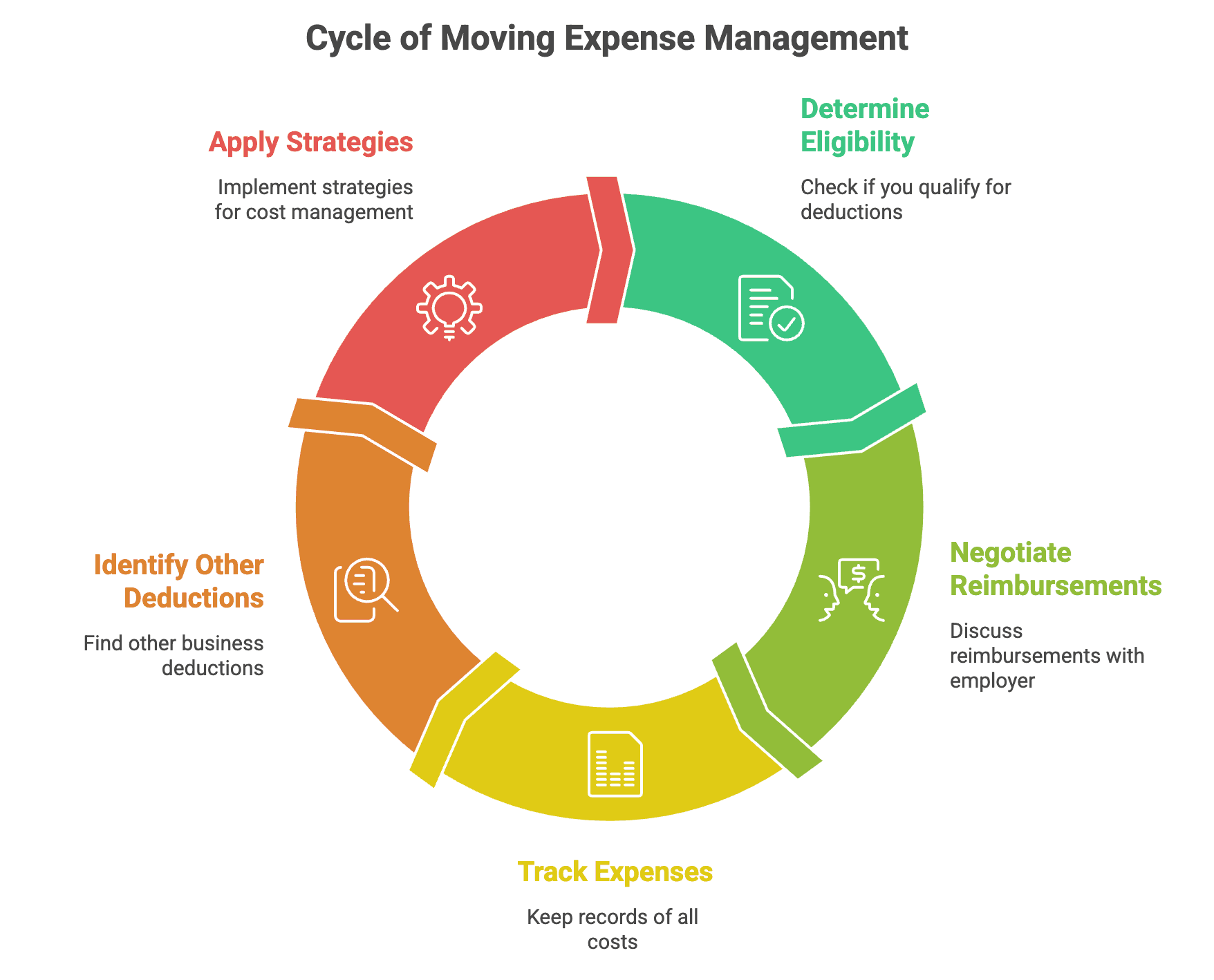
For most startup leaders, this means you cannot currently deduct personal moving expenses under federal law. Instead, apply these strategies:
Negotiate employer reimbursements and understand their tax implications.
Track moving-related costs carefully to distinguish between reimbursed and unreimbursed expenses.
Look for other qualified business deductions that may indirectly offset your moving-related costs.
Deductible Moving Expenses Under Form 3903
When eligible, moving expense deductions rely on meeting the following tests:
Core Eligibility Tests
Distance Test: Your new workplace must be at least 50 miles farther from your old home than your previous job location.
Time Test: You must work full-time for at least 39 weeks during the first 12 months after your move.
Qualified Expenses Include:
Expense Category | Examples | Notes |
Moving Household Goods | Packing, crating, transporting (truck rental, movers' fees) | Must be reasonable and necessary |
Travel Costs | Transportation and lodging for you and your family | Meals are excluded since 2018 |
Storage Fees | Temporary storage of household goods (up to 30 days) | Receipts and timelines must be kept |
Utility Connection Fees | Initiating services at the new home | Generally not deductible |
Expenses Explicitly Not Deductible:
Meals while traveling
House-hunting trips
Fees associated with buying or selling a home
Any expenses covered by your employer
Practical Example
Imagine you’re an active-duty military founder relocating 60 miles due to a permanent change of station. Your allowable expenses could include truck rentals, packing service, and hotel lodging for the trip. Meals on the road? Not covered. Save receipts and logs carefully for each qualified item.
Documenting Moving Expenses: Best Practices
Accurate documentation is your safety net. It proves eligibility, supports your case during an IRS review, and informs your internal financial reporting.
Essential Records to Keep
Document Type | Purpose | Pro Tips |
Receipts and Invoices | Validates expense origin | Scan copies digitally and organize by category |
Employment Orders or Notices | Proof of move requirement (military) | Store official documents securely |
Mileage Logs | Justify travel distances | Use mobile tracking apps for accuracy |
Expense Spreadsheets | Categorize all expenses | Update frequently and review for errors |
Reimbursement Confirmations | Avoid duplicate deductions | Tag with payment method and disclosure status |
Organization Framework
Create a digital folder titled “Moving Expenses [Year]” with subfolders by category (transportation, travel, etc.).
Build a spreadsheet including: date, vendor, category, amount, reimbursed status, and notes.
Take photos of paper receipts on the go; sync with cloud storage regularly.
Strategic Considerations for Startups and Agencies
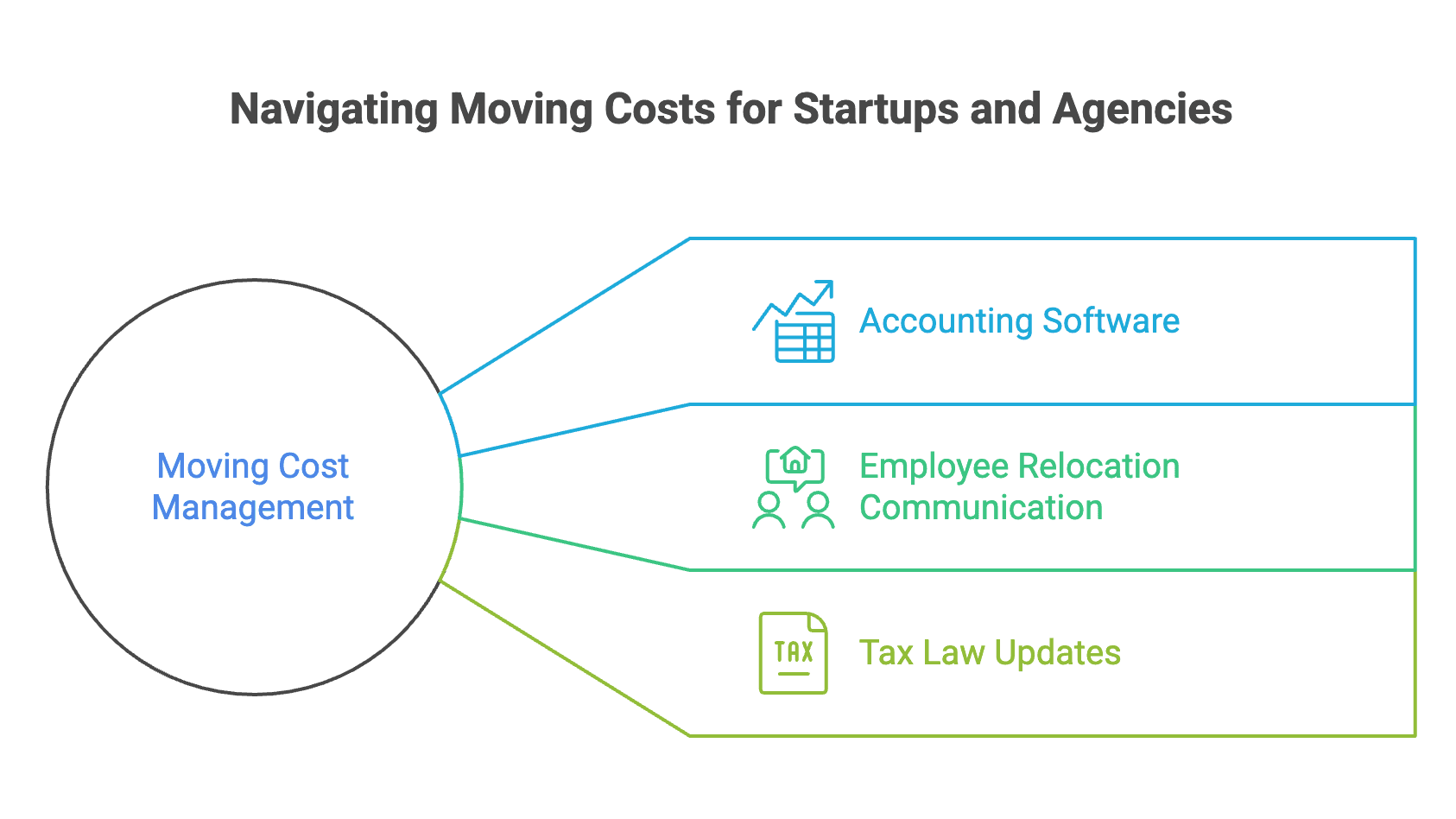
Even if you can't use Form 3903 right now, managing moving-related costs with foresight and structure carries value.
Use accounting software (e.g., QuickBooks, Xero, or a startup-focused platform) to label relocation expenses properly.
If your company funds employee relocations, communicate which expenses are taxable and provide guidance on documentation.
Periodically review tax law updates, especially if your sector involves defense, federal contracts, or international mobility.
For more on compliant bookkeeping and tax-positioning for founders, read our business tax services guide.
Where and How to File Form 3903
You’ll file Form 3903 alongside your Form 1040 for the tax year in which you made the qualifying move.
Key Notes:
Only eligible parties (primarily military personnel) should file Form 3903 presently.
If you qualify and forgot to claim in a past year before 2018, you can amend using Form 1040X with Form 3903 attached.
Don't include any employer-paid expenses when calculating your deduction.
Double-check eligibility with a tax professional before filing.
Takeaways on Form 3903 and Deductible Moving Costs
Understanding Form 3903 and the current limitations on moving expense deductions helps founders and finance leads operate with clarity. While the deduction is currently constrained to military personnel, it's still vital to:
Organize relocation expense data logically and consistently
Communicate expectations with employees during high-growth scaling
Relocating your business or yourself for work is a significant event demanding not only operational planning but also careful financial consideration. For founders, COOs, and heads of finance leading US startups, agencies, and e-commerce companies, understanding the nuances of Form 3903 is essential to capitalize on potential tax deductions related to moving costs.
This guide breaks down eligibility criteria, allowable expenses, and documentation strategies to help you make savvy, founder-focused accounting decisions — ensuring your moving expenses work in your tax advantage where possible.
Form 3903 and Its Current Scope
Form 3903, the Moving Expenses Deduction form, was created to support taxpayers moving for job-related reasons by allowing a deduction of certain moving costs. However, due to the Tax Cuts and Jobs Act (TCJA) enacted in 2017, the rules for deducting moving expenses tightened significantly, limiting eligibility primarily to active-duty military personnel moving under orders.
Who Can Currently Use Form 3903?
Active-duty military members relocating due to a permanent change of station remain eligible to claim moving expense deductions using Form 3903.
Starting in 2026, some intelligence community employees may regain eligibility under specific legislative conditions.
For most non-military taxpayers, the TCJA disallows moving expense deductions for tax years 2018 through 2025. Individuals can amend past returns if moving expenses from earlier years were not properly accounted for.
Note: Employers often reimburse moving expenses directly; in such cases, these amounts cannot be deducted.
Are Founders, Executives, and Employees Eligible to Deduct Moving Expenses?
If you’re a founder or executive relocating your startup or moving to take on a leadership role at a different company, it’s crucial to understand that personal moving costs generally are not deductible for tax years 2018–2025. This limitation influences how you should approach moving expense planning.
The exceptions include:
You are active-duty military personnel moving due to orders.
Your move occurs in 2026 or later, and you qualify under new rules regarding intelligence community personnel.
Certain states may offer more lenient moving expense deduction rules, though Form 3903 applies at the federal level.
For most startup leaders, this means you cannot currently deduct personal moving expenses under federal law. Instead, apply these strategies:
Negotiate employer reimbursements and understand their tax implications.
Track moving-related costs carefully to distinguish between reimbursed and unreimbursed expenses.
Look for other qualified business deductions that may indirectly offset your moving-related costs.
Deductible Moving Expenses Under Form 3903
When eligible, moving expense deductions rely on meeting the following tests:
Core Eligibility Tests
Distance Test: Your new workplace must be at least 50 miles farther from your old home than your previous job location.
Time Test: You must work full-time for at least 39 weeks during the first 12 months after your move.
Qualified Expenses Include:
Expense Category | Examples | Notes |
Moving Household Goods | Packing, crating, transporting (truck rental, movers' fees) | Must be reasonable and necessary |
Travel Costs | Transportation and lodging for you and your family | Meals are excluded since 2018 |
Storage Fees | Temporary storage of household goods (up to 30 days) | Receipts and timelines must be kept |
Utility Connection Fees | Initiating services at the new home | Generally not deductible |
Expenses Explicitly Not Deductible:
Meals while traveling
House-hunting trips
Fees associated with buying or selling a home
Any expenses covered by your employer
Practical Example
Imagine you’re an active-duty military founder relocating 60 miles due to a permanent change of station. Your allowable expenses could include truck rentals, packing service, and hotel lodging for the trip. Meals on the road? Not covered. Save receipts and logs carefully for each qualified item.
Documenting Moving Expenses: Best Practices
Accurate documentation is your safety net. It proves eligibility, supports your case during an IRS review, and informs your internal financial reporting.
Essential Records to Keep
Document Type | Purpose | Pro Tips |
Receipts and Invoices | Validates expense origin | Scan copies digitally and organize by category |
Employment Orders or Notices | Proof of move requirement (military) | Store official documents securely |
Mileage Logs | Justify travel distances | Use mobile tracking apps for accuracy |
Expense Spreadsheets | Categorize all expenses | Update frequently and review for errors |
Reimbursement Confirmations | Avoid duplicate deductions | Tag with payment method and disclosure status |
Organization Framework
Create a digital folder titled “Moving Expenses [Year]” with subfolders by category (transportation, travel, etc.).
Build a spreadsheet including: date, vendor, category, amount, reimbursed status, and notes.
Take photos of paper receipts on the go; sync with cloud storage regularly.
Strategic Considerations for Startups and Agencies
Even if you can't use Form 3903 right now, managing moving-related costs with foresight and structure carries value.
Use accounting software (e.g., QuickBooks, Xero, or a startup-focused platform) to label relocation expenses properly.
If your company funds employee relocations, communicate which expenses are taxable and provide guidance on documentation.
Periodically review tax law updates, especially if your sector involves defense, federal contracts, or international mobility.
For more on compliant bookkeeping and tax-positioning for founders, read our business tax services guide.
Where and How to File Form 3903
You’ll file Form 3903 alongside your Form 1040 for the tax year in which you made the qualifying move.
Key Notes:
Only eligible parties (primarily military personnel) should file Form 3903 presently.
If you qualify and forgot to claim in a past year before 2018, you can amend using Form 1040X with Form 3903 attached.
Don't include any employer-paid expenses when calculating your deduction.
Double-check eligibility with a tax professional before filing.
Takeaways on Form 3903 and Deductible Moving Costs
Understanding Form 3903 and the current limitations on moving expense deductions helps founders and finance leads operate with clarity. While the deduction is currently constrained to military personnel, it's still vital to:
Organize relocation expense data logically and consistently
Communicate expectations with employees during high-growth scaling
This article was co-written by:
Content
This article was co-written by:
2026
© Haven All Rights Reserved
Haven is a financial technology company, not an FDIC-insured bank. Banking services are provided by OMB Bank, Member FDIC. Deposits in checking and savings accounts are held at OMB Bank and are insured by the FDIC up to the applicable limits. FDIC insurance covers the failure of an insured bank. Certain conditions must be met for pass-through insurance coverage to apply. Fees, terms, and conditions apply to depositing and using your account.
2026
© Haven All Rights Reserved
Haven is a financial technology company, not an FDIC-insured bank. Banking services are provided by OMB Bank, Member FDIC. Deposits in checking and savings accounts are held at OMB Bank and are insured by the FDIC up to the applicable limits. FDIC insurance covers the failure of an insured bank. Certain conditions must be met for pass-through insurance coverage to apply. Fees, terms, and conditions apply to depositing and using your account.
2026
© Haven All Rights Reserved
Haven is a financial technology company, not an FDIC-insured bank. Banking services are provided by OMB Bank, Member FDIC. Deposits in checking and savings accounts are held at OMB Bank and are insured by the FDIC up to the applicable limits. FDIC insurance covers the failure of an insured bank. Certain conditions must be met for pass-through insurance coverage to apply. Fees, terms, and conditions apply to depositing and using your account.