Go Back
Last Updated :
Last Updated :
Mar 9, 2026
Mar 9, 2026

Form 1045: Fast-Track Your Tax Refund with the Quick Refund Application
Every startup founder or finance lead knows tax season is challenging – especially when businesses face operating losses. But did you know there’s a powerful, often underutilized tool to reclaim funds faster during tough years? Form 1045 offers a rapid pathway to receive a tentative refund by carrying back net operating losses (NOLs) or certain tax credits, unlocking essential cash flow when your startup needs it most.
In this guide, you'll learn what Form 1045 is, who qualifies, and how to file it properly to fast-track your tax refund. Leveraging this IRS process can be a game-changer for startup cash management.
Understanding Form 1045 and Why It Matters
Form 1045, Application for Tentative Refund, is an IRS tool designed to help businesses and individuals accelerate refunds resulting from NOL carrybacks or certain tax credits like the R&D tax credit. Unlike typical amended returns (Form 1040X), which can take months to process, Form 1045 moves faster—usually within about 90 days—resulting in earlier access to vital funds.
How Does Form 1045 Work?
Form 1045 allows you to apply for a “tentative refund” by carrying back losses or credits from your current tax year to previous profitable years. The IRS then issues a refund based on that prior tax data, instead of waiting for the standard amended refund timeline that can extend multiple months. This refund is considered “tentative” because it’s subject to final IRS review.
Who Qualifies to File Form 1045?
Individuals, Estates, and Trusts: These entities, experiencing net operating losses or tax credits, can file.
Businesses, Including Startups: Particularly relevant for startups with unpredictable revenue and expenses, where operating losses one year can be carried back to offset prior year taxable income.
Loss Types: Most commonly, businesses filing Form 1045 seek to apply NOL carrybacks or general business credits, such as the R&D tax credit.
Startups and e-commerce companies that qualify for the R&D tax credit or have experienced losses may benefit greatly from filing this form to accelerate refunds.
How to File Form 1045 for Faster Refunds
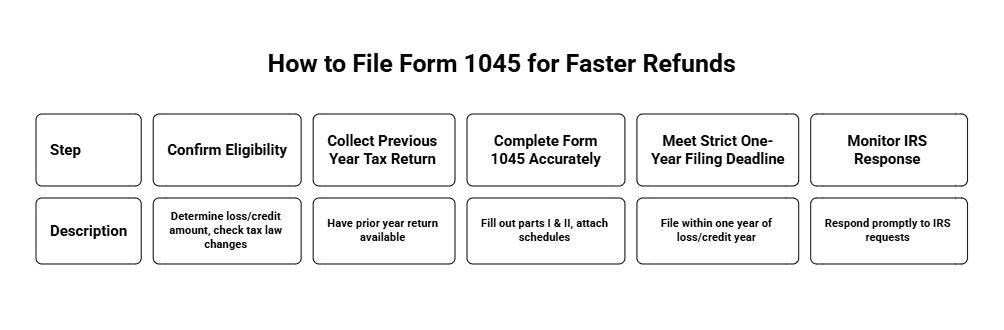
Filing Form 1045 involves careful preparation and adherence to deadlines but can unlock critical liquidity. Here’s the actionable process:
1. Confirm Eligibility and the Loss or Credit to Carry Back
Determine your loss amount eligible for carryback, referencing your completed tax return for the loss year.
Identify applicable tax credits if relevant – for instance, R&D tax credits.
Understand changes from recent tax laws (e.g., Tax Cuts and Jobs Act, CARES Act), which may limit or expand eligibility.
2. Collect Previous Year Tax Return Information
Have the prior tax year’s return available. This is necessary to compute how the carryback affects your previously reported taxable income and taxes paid.
3. Complete Form 1045 Accurately
Key sections include:
Part I: Basic taxpayer info and purpose for filing (loss or credit carryback).
Part II: Estimate the refund by recalculating prior tax year income with the NOL or credits applied.
Schedules: Attach all required calculations and supporting documents. Most startups must attach detailed computations of the NOL or carryback credit.
Tip: File electronically if possible. It’s usually faster and easier than filing by mail.
4. Meet the Strict One-Year Filing Deadline
Form 1045 must be filed within one year after the end of the tax year in which the loss or credit arose. Missing this cut-off forfeits eligibility for the tentative refund process (though you may still pursue an amended return).
5. Monitor IRS Response
Refunds typically process within 90 days. However, expect the IRS to request documentation or clarification, especially for large refund requests. Respond promptly to avoid processing delays.
Form 1045 vs. Related IRS Forms: Key Differences
Startup leaders may confuse Form 1045 with related forms. Here’s how they differ:
Feature | Form 1045 | Form 1040X | Form 1041 |
Who files | Individuals, estates, trusts | Individuals | Estates, trusts |
Type of refund | Tentative refund (faster) | Final refund (longer wait) | Final refund (estate/trust income) |
Deadline to file | 1 year after loss/credit year | 3 years after original filing | 3 years after original filing |
Risk of IRS adjustments | Higher (tentative review) | Lower | Lower |
Speed of refund | ~90 days | 4–6+ months | 4–6+ months |
If you need fast cash flow relief, Form 1045 offers earlier access versus the longer amended return pathway.
For foundational tax concepts and deadlines, check our startup tax guide.
Key Considerations for Filing Form 1045
NOL Carrybacks Since the TCJA
The Tax Cuts and Jobs Act of 2017 generally removed NOL carrybacks starting 2018, except for certain sectors (e.g., farming, insurance). The CARES Act later reinstated five-year carrybacks for losses from 2018 through 2020.
If claiming losses from earlier years, understand whether a carryback is allowed for the loss year in question. IRS publication About Form 1045 offers current guidance.
Leveraging R&D Tax Credits with Form 1045
Startups investing in research, engineering, or software development may qualify for the R&D tax credit. If the credit generates unused amounts, Form 1045 enables you to roll them back to earlier profitable years for a potentially sizable refund.
Mistakes to Avoid When Filing
Late submission: After one year, you can’t file Form 1045—even if eligible.
Incomplete computations: Incorrect or missing NOL calculations delay refunds.
Missing backup documents: IRS examinations often request supporting worksheets, so be prepared.
Final Tips to Maximize Refund Value and Speed
Tip | Why It Matters |
File within 1 year of the loss/credit year | Ensures you're eligible for Form 1045 vs longer amended return delays |
Keep robust documentation | IRS expects detailed proofs of NOL or credit computations |
Consider R&D credit eligibility | Properly claimed R&D credits increase refund potential |
Use startup-friendly tools and advisors | Boosts compliance and speed; reduces room for error or missed opportunities |
Unlock Cash Flow Sooner with Form 1045
For fast-growing startups and resource-conscious founders, timely tax refunds can impact runway and scale decisions. Using Form 1045 strategically enables you to tap into prior profits through loss or credit carrybacks, lowering cash constraints by accelerating refunds.
As startups face income volatility, mastering Form 1045 becomes a potent financial lever to reclaim cash fast. Tap professional help and ensure same-year filing to avoid wasted opportunities.
Every startup founder or finance lead knows tax season is challenging – especially when businesses face operating losses. But did you know there’s a powerful, often underutilized tool to reclaim funds faster during tough years? Form 1045 offers a rapid pathway to receive a tentative refund by carrying back net operating losses (NOLs) or certain tax credits, unlocking essential cash flow when your startup needs it most.
In this guide, you'll learn what Form 1045 is, who qualifies, and how to file it properly to fast-track your tax refund. Leveraging this IRS process can be a game-changer for startup cash management.
Understanding Form 1045 and Why It Matters
Form 1045, Application for Tentative Refund, is an IRS tool designed to help businesses and individuals accelerate refunds resulting from NOL carrybacks or certain tax credits like the R&D tax credit. Unlike typical amended returns (Form 1040X), which can take months to process, Form 1045 moves faster—usually within about 90 days—resulting in earlier access to vital funds.
How Does Form 1045 Work?
Form 1045 allows you to apply for a “tentative refund” by carrying back losses or credits from your current tax year to previous profitable years. The IRS then issues a refund based on that prior tax data, instead of waiting for the standard amended refund timeline that can extend multiple months. This refund is considered “tentative” because it’s subject to final IRS review.
Who Qualifies to File Form 1045?
Individuals, Estates, and Trusts: These entities, experiencing net operating losses or tax credits, can file.
Businesses, Including Startups: Particularly relevant for startups with unpredictable revenue and expenses, where operating losses one year can be carried back to offset prior year taxable income.
Loss Types: Most commonly, businesses filing Form 1045 seek to apply NOL carrybacks or general business credits, such as the R&D tax credit.
Startups and e-commerce companies that qualify for the R&D tax credit or have experienced losses may benefit greatly from filing this form to accelerate refunds.
How to File Form 1045 for Faster Refunds
Filing Form 1045 involves careful preparation and adherence to deadlines but can unlock critical liquidity. Here’s the actionable process:
1. Confirm Eligibility and the Loss or Credit to Carry Back
Determine your loss amount eligible for carryback, referencing your completed tax return for the loss year.
Identify applicable tax credits if relevant – for instance, R&D tax credits.
Understand changes from recent tax laws (e.g., Tax Cuts and Jobs Act, CARES Act), which may limit or expand eligibility.
2. Collect Previous Year Tax Return Information
Have the prior tax year’s return available. This is necessary to compute how the carryback affects your previously reported taxable income and taxes paid.
3. Complete Form 1045 Accurately
Key sections include:
Part I: Basic taxpayer info and purpose for filing (loss or credit carryback).
Part II: Estimate the refund by recalculating prior tax year income with the NOL or credits applied.
Schedules: Attach all required calculations and supporting documents. Most startups must attach detailed computations of the NOL or carryback credit.
Tip: File electronically if possible. It’s usually faster and easier than filing by mail.
4. Meet the Strict One-Year Filing Deadline
Form 1045 must be filed within one year after the end of the tax year in which the loss or credit arose. Missing this cut-off forfeits eligibility for the tentative refund process (though you may still pursue an amended return).
5. Monitor IRS Response
Refunds typically process within 90 days. However, expect the IRS to request documentation or clarification, especially for large refund requests. Respond promptly to avoid processing delays.
Form 1045 vs. Related IRS Forms: Key Differences
Startup leaders may confuse Form 1045 with related forms. Here’s how they differ:
Feature | Form 1045 | Form 1040X | Form 1041 |
Who files | Individuals, estates, trusts | Individuals | Estates, trusts |
Type of refund | Tentative refund (faster) | Final refund (longer wait) | Final refund (estate/trust income) |
Deadline to file | 1 year after loss/credit year | 3 years after original filing | 3 years after original filing |
Risk of IRS adjustments | Higher (tentative review) | Lower | Lower |
Speed of refund | ~90 days | 4–6+ months | 4–6+ months |
If you need fast cash flow relief, Form 1045 offers earlier access versus the longer amended return pathway.
For foundational tax concepts and deadlines, check our startup tax guide.
Key Considerations for Filing Form 1045
NOL Carrybacks Since the TCJA
The Tax Cuts and Jobs Act of 2017 generally removed NOL carrybacks starting 2018, except for certain sectors (e.g., farming, insurance). The CARES Act later reinstated five-year carrybacks for losses from 2018 through 2020.
If claiming losses from earlier years, understand whether a carryback is allowed for the loss year in question. IRS publication About Form 1045 offers current guidance.
Leveraging R&D Tax Credits with Form 1045
Startups investing in research, engineering, or software development may qualify for the R&D tax credit. If the credit generates unused amounts, Form 1045 enables you to roll them back to earlier profitable years for a potentially sizable refund.
Mistakes to Avoid When Filing
Late submission: After one year, you can’t file Form 1045—even if eligible.
Incomplete computations: Incorrect or missing NOL calculations delay refunds.
Missing backup documents: IRS examinations often request supporting worksheets, so be prepared.
Final Tips to Maximize Refund Value and Speed
Tip | Why It Matters |
File within 1 year of the loss/credit year | Ensures you're eligible for Form 1045 vs longer amended return delays |
Keep robust documentation | IRS expects detailed proofs of NOL or credit computations |
Consider R&D credit eligibility | Properly claimed R&D credits increase refund potential |
Use startup-friendly tools and advisors | Boosts compliance and speed; reduces room for error or missed opportunities |
Unlock Cash Flow Sooner with Form 1045
For fast-growing startups and resource-conscious founders, timely tax refunds can impact runway and scale decisions. Using Form 1045 strategically enables you to tap into prior profits through loss or credit carrybacks, lowering cash constraints by accelerating refunds.
As startups face income volatility, mastering Form 1045 becomes a potent financial lever to reclaim cash fast. Tap professional help and ensure same-year filing to avoid wasted opportunities.
This article was co-written by:
Content
This article was co-written by:
2026
© Haven All Rights Reserved
Haven is a financial technology company, not an FDIC-insured bank. Deposit account services are provided by OMB Bank, Member FDIC. Funds deposited into eligible checking and savings accounts are held at OMB Bank and may be eligible for FDIC insurance up to applicable limits. FDIC insurance protects against the failure of an FDIC-insured bank. Certain conditions must be satisfied for pass-through deposit insurance coverage to apply. Fees, terms, and conditions apply.
Cryptocurrency products and services are separate from the deposit account services provided by OMB Bank. Cryptocurrency is not offered, sponsored, endorsed, administered, held, or supported by OMB Bank. Cryptocurrency and other digital assets are not deposits, are not FDIC-insured, are not guaranteed by OMB Bank, and may lose value.
2026
© Haven All Rights Reserved
Haven is a financial technology company, not an FDIC-insured bank. Deposit account services are provided by OMB Bank, Member FDIC. Funds deposited into eligible checking and savings accounts are held at OMB Bank and may be eligible for FDIC insurance up to applicable limits. FDIC insurance protects against the failure of an FDIC-insured bank. Certain conditions must be satisfied for pass-through deposit insurance coverage to apply. Fees, terms, and conditions apply.
Cryptocurrency products and services are separate from the deposit account services provided by OMB Bank. Cryptocurrency is not offered, sponsored, endorsed, administered, held, or supported by OMB Bank. Cryptocurrency and other digital assets are not deposits, are not FDIC-insured, are not guaranteed by OMB Bank, and may lose value.
2026
© Haven All Rights Reserved
Haven is a financial technology company, not an FDIC-insured bank. Deposit account services are provided by OMB Bank, Member FDIC. Funds deposited into eligible checking and savings accounts are held at OMB Bank and may be eligible for FDIC insurance up to applicable limits. FDIC insurance protects against the failure of an FDIC-insured bank. Certain conditions must be satisfied for pass-through deposit insurance coverage to apply. Fees, terms, and conditions apply.
Cryptocurrency products and services are separate from the deposit account services provided by OMB Bank. Cryptocurrency is not offered, sponsored, endorsed, administered, held, or supported by OMB Bank. Cryptocurrency and other digital assets are not deposits, are not FDIC-insured, are not guaranteed by OMB Bank, and may lose value.