Go Back
Last Updated :
Last Updated :
Dec 1, 2025
Dec 1, 2025

A Practical Guide to Bookkeeping for Contractors
As a founder or operations lead managing a contracting business, bookkeeping for contractors is a foundational discipline that directly affects your project's profitability and your company’s long-term sustainability. Unlike traditional business bookkeeping, contractor bookkeeping comes with unique challenges: tracking multiple projects, managing different clients and timelines, and accounting for various expenses and labor costs across jobs. Getting your financial tracking right isn’t just about compliance — it’s a strategic lever to optimize cash flow, price jobs accurately, and scale effectively.
In this guide, we’ll walk you through the essential bookkeeping practices tailored for contractors. We’ll cover how to design your bookkeeping system for clear project visibility, handle key accounting details that can make or break your profit margins, and use your financial data to make smarter business decisions. Along the way, you’ll find practical examples, common pitfalls, and resources so you can build a bookkeeping process that supports your growth.
Why Contractor Bookkeeping Is Different — and Why It Matters
Contractors operate in a fast-moving, project-driven environment. You’re hired to complete a job, often under variable scopes and tight deadlines, where costs and revenues fluctuate more with project cycles than calendar months. That dynamic demands a different bookkeeping approach tailored to:
Track income and expenses by project: Profitability lives at the project level. You need clean project-by-project financial visibility.
Manage unpredictable cash flow timing: With upfront costs and staggered payments, you risk cash shortfalls without strong project-based receivables tracking.
Capture labor costs accurately: Employees and subs drive the work. Labor costs often outsize materials in your budget.
Ensure tax compliance: From 1099s for subs to sales tax on materials, it’s your job to keep organized records.
Neglecting these means projects that lose money quietly, growing stress chasing payments, or surprise tax penalties. Smart bookkeeping for contractors turns these risks into performance signals to help you bid better, spend smarter, and grow faster.
For broader fundamentals, explore Haven’s resource on bookkeeping best practices.
Core Bookkeeping Essentials for Profitable Contractor Operations
Set Up Project-Based Accounting from the Start
Job costing is non-negotiable. Your books must separate revenues and expenses by project so that you can:
Create individual projects or jobs in your accounting software.
Tag every transaction — income, labor, material purchase, or overhead — to a project.
Track project profitability versus your estimates to catch margin slippage fast.
If you use QuickBooks Online, leverage their Projects tool. In Xero or other tools, use tracking categories or classes.
For more, QuickBooks provides guidance on job costing best practices.
Monitor Labor and Subcontractor Costs Accurately
Labor is likely your largest cost — and one of the most variable.
Get a time-tracking app that feeds directly into your payroll and accounting system.
Assign hours (employee or subcontractor) to specific jobs so you know where time is going.
Make sure every subcontractor has an accurate W-9 and you record all payments for 1099 reporting.
With subcontractors, ensure you archive signed contracts and all invoices.
Stay Ahead of Cash Flow with Receivables Tracking
Link your invoices to project milestones.
Send invoices quickly, and add payment terms and late-payment triggers.
Follow up weekly on open invoices—use automation if needed.
Cash flow timing is frequently what breaks contracting businesses — not price or quality.
Record and Categorize All Expenses to Prevent Margin Leaks
Systemize your expense tracking:
Require digital receipts.
Log every purchase — fuel, materials, porta potty rental — against the appropriate job.
Distinguish between direct job expenses and overhead.
Accurate classification ensures transparent budgeting and clean job-cost reporting.
Run Reports More Frequently — Weekly or Monthly
Report Type | Purpose | Frequency |
Project profit summary | Track actual margin vs. estimated | Monthly or per milestone |
Cash flow forecast | Plan spending vs. incoming payments | Weekly or bi-weekly |
Labor cost variance | Detect overruns per job | Monthly |
Subcontractor summary | Ensure 1099 compliance and cost control | Quarterly |
Growth Tactics: Bookkeeping Moves That Scale With You
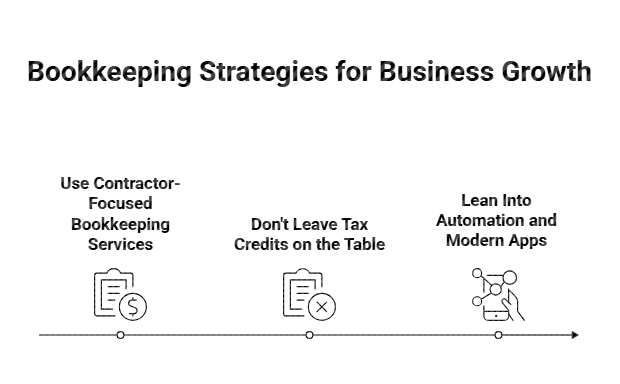
Use Contractor-Focused Bookkeeping Services
Specialized services like Haven streamline:
Categorizing transactions by project
Tracking labor and contractor costs
Syncing payroll
Building cash flow forecasts
See Haven’s solutions: Haven’s bookkeeping services.
Don’t Leave Tax Credits on the Table
You might qualify for overlooked deductions and credits:
Truck leases
Rental equipment
Jobsite materials
R&D tax credit (for design-build or engineering-heavy work)
Learn more from SBA.gov on business tax credits.
Lean Into Automation and Modern Apps
Use tools like:
Dext
QuickBooks Receipt Capture
Time-tracking apps like TSheets or Clockify
Real-time data prevents surprises and keeps your projects profitable.
Make Bookkeeping for Contractors Your Competitive Advantage
For contracting founders, mastering bookkeeping for contractors is not just a compliance check—it’s a critical advantage. It helps you:
Keep every project profitable
Avoid cash flow crises
Price your bids intelligently
Scale with confidence
Taking the time to build quality bookkeeping practices now saves countless hours later. And if you’d rather not do it alone…
Your projects are your business’s lifeblood — keep them healthy, agile, and profitable with the right financial systems in place.
As a founder or operations lead managing a contracting business, bookkeeping for contractors is a foundational discipline that directly affects your project's profitability and your company’s long-term sustainability. Unlike traditional business bookkeeping, contractor bookkeeping comes with unique challenges: tracking multiple projects, managing different clients and timelines, and accounting for various expenses and labor costs across jobs. Getting your financial tracking right isn’t just about compliance — it’s a strategic lever to optimize cash flow, price jobs accurately, and scale effectively.
In this guide, we’ll walk you through the essential bookkeeping practices tailored for contractors. We’ll cover how to design your bookkeeping system for clear project visibility, handle key accounting details that can make or break your profit margins, and use your financial data to make smarter business decisions. Along the way, you’ll find practical examples, common pitfalls, and resources so you can build a bookkeeping process that supports your growth.
Why Contractor Bookkeeping Is Different — and Why It Matters
Contractors operate in a fast-moving, project-driven environment. You’re hired to complete a job, often under variable scopes and tight deadlines, where costs and revenues fluctuate more with project cycles than calendar months. That dynamic demands a different bookkeeping approach tailored to:
Track income and expenses by project: Profitability lives at the project level. You need clean project-by-project financial visibility.
Manage unpredictable cash flow timing: With upfront costs and staggered payments, you risk cash shortfalls without strong project-based receivables tracking.
Capture labor costs accurately: Employees and subs drive the work. Labor costs often outsize materials in your budget.
Ensure tax compliance: From 1099s for subs to sales tax on materials, it’s your job to keep organized records.
Neglecting these means projects that lose money quietly, growing stress chasing payments, or surprise tax penalties. Smart bookkeeping for contractors turns these risks into performance signals to help you bid better, spend smarter, and grow faster.
For broader fundamentals, explore Haven’s resource on bookkeeping best practices.
Core Bookkeeping Essentials for Profitable Contractor Operations
Set Up Project-Based Accounting from the Start
Job costing is non-negotiable. Your books must separate revenues and expenses by project so that you can:
Create individual projects or jobs in your accounting software.
Tag every transaction — income, labor, material purchase, or overhead — to a project.
Track project profitability versus your estimates to catch margin slippage fast.
If you use QuickBooks Online, leverage their Projects tool. In Xero or other tools, use tracking categories or classes.
For more, QuickBooks provides guidance on job costing best practices.
Monitor Labor and Subcontractor Costs Accurately
Labor is likely your largest cost — and one of the most variable.
Get a time-tracking app that feeds directly into your payroll and accounting system.
Assign hours (employee or subcontractor) to specific jobs so you know where time is going.
Make sure every subcontractor has an accurate W-9 and you record all payments for 1099 reporting.
With subcontractors, ensure you archive signed contracts and all invoices.
Stay Ahead of Cash Flow with Receivables Tracking
Link your invoices to project milestones.
Send invoices quickly, and add payment terms and late-payment triggers.
Follow up weekly on open invoices—use automation if needed.
Cash flow timing is frequently what breaks contracting businesses — not price or quality.
Record and Categorize All Expenses to Prevent Margin Leaks
Systemize your expense tracking:
Require digital receipts.
Log every purchase — fuel, materials, porta potty rental — against the appropriate job.
Distinguish between direct job expenses and overhead.
Accurate classification ensures transparent budgeting and clean job-cost reporting.
Run Reports More Frequently — Weekly or Monthly
Report Type | Purpose | Frequency |
Project profit summary | Track actual margin vs. estimated | Monthly or per milestone |
Cash flow forecast | Plan spending vs. incoming payments | Weekly or bi-weekly |
Labor cost variance | Detect overruns per job | Monthly |
Subcontractor summary | Ensure 1099 compliance and cost control | Quarterly |
Growth Tactics: Bookkeeping Moves That Scale With You
Use Contractor-Focused Bookkeeping Services
Specialized services like Haven streamline:
Categorizing transactions by project
Tracking labor and contractor costs
Syncing payroll
Building cash flow forecasts
See Haven’s solutions: Haven’s bookkeeping services.
Don’t Leave Tax Credits on the Table
You might qualify for overlooked deductions and credits:
Truck leases
Rental equipment
Jobsite materials
R&D tax credit (for design-build or engineering-heavy work)
Learn more from SBA.gov on business tax credits.
Lean Into Automation and Modern Apps
Use tools like:
Dext
QuickBooks Receipt Capture
Time-tracking apps like TSheets or Clockify
Real-time data prevents surprises and keeps your projects profitable.
Make Bookkeeping for Contractors Your Competitive Advantage
For contracting founders, mastering bookkeeping for contractors is not just a compliance check—it’s a critical advantage. It helps you:
Keep every project profitable
Avoid cash flow crises
Price your bids intelligently
Scale with confidence
Taking the time to build quality bookkeeping practices now saves countless hours later. And if you’d rather not do it alone…
Your projects are your business’s lifeblood — keep them healthy, agile, and profitable with the right financial systems in place.
This article was co-written by:
Content
This article was co-written by:
2026
© Haven All Rights Reserved
Haven is a financial technology company, not an FDIC-insured bank. Deposit account services are provided by OMB Bank, Member FDIC. Funds deposited into eligible checking and savings accounts are held at OMB Bank and may be eligible for FDIC insurance up to applicable limits. FDIC insurance protects against the failure of an FDIC-insured bank. Certain conditions must be satisfied for pass-through deposit insurance coverage to apply. Fees, terms, and conditions apply.
Cryptocurrency products and services are separate from the deposit account services provided by OMB Bank. Cryptocurrency is not offered, sponsored, endorsed, administered, held, or supported by OMB Bank. Cryptocurrency and other digital assets are not deposits, are not FDIC-insured, are not guaranteed by OMB Bank, and may lose value.
2026
© Haven All Rights Reserved
Haven is a financial technology company, not an FDIC-insured bank. Deposit account services are provided by OMB Bank, Member FDIC. Funds deposited into eligible checking and savings accounts are held at OMB Bank and may be eligible for FDIC insurance up to applicable limits. FDIC insurance protects against the failure of an FDIC-insured bank. Certain conditions must be satisfied for pass-through deposit insurance coverage to apply. Fees, terms, and conditions apply.
Cryptocurrency products and services are separate from the deposit account services provided by OMB Bank. Cryptocurrency is not offered, sponsored, endorsed, administered, held, or supported by OMB Bank. Cryptocurrency and other digital assets are not deposits, are not FDIC-insured, are not guaranteed by OMB Bank, and may lose value.
2026
© Haven All Rights Reserved
Haven is a financial technology company, not an FDIC-insured bank. Deposit account services are provided by OMB Bank, Member FDIC. Funds deposited into eligible checking and savings accounts are held at OMB Bank and may be eligible for FDIC insurance up to applicable limits. FDIC insurance protects against the failure of an FDIC-insured bank. Certain conditions must be satisfied for pass-through deposit insurance coverage to apply. Fees, terms, and conditions apply.
Cryptocurrency products and services are separate from the deposit account services provided by OMB Bank. Cryptocurrency is not offered, sponsored, endorsed, administered, held, or supported by OMB Bank. Cryptocurrency and other digital assets are not deposits, are not FDIC-insured, are not guaranteed by OMB Bank, and may lose value.