Go Back
Last Updated :
Last Updated :
Jan 19, 2026
Jan 19, 2026

Net Investment Income Tax (NIIT) Explained for Founders: Form 8960 Overview
For founders steering the financial course of startups, agencies, or e-commerce ventures, understanding specialized tax forms like Form 8960 is essential for optimizing tax outcomes. This guide provides a founder-friendly breakdown of the Net Investment Income Tax (NIIT), explaining how to calculate it using Form 8960 and why it matters for your business and personal finances.
What is Form 8960 and Why Should Founders Care?
Form 8960 is the IRS form used to calculate the Net Investment Income Tax (NIIT), a 3.8% surtax applied to certain investment income for individuals, estates, and trusts that exceed specified income thresholds.
Why does this affect founders?
Many founders' personal incomes include dividends, interest, capital gains, rental income, or other passive incomes derived from investments and business activities. If your modified adjusted gross income (MAGI) surpasses the threshold, you may owe NIIT on your net investment income — impacting your after-tax wealth and reinvestment capacity.
Understanding Form 8960 enables founders to:
Accurately determine NIIT liability
Strategically manage investments to minimize tax burden
Align accounting and tax filings for compliance
Understanding Net Investment Income Tax on Form 8960
Form 8960 calculates NIIT based on two key concepts — your net investment income and whether your MAGI exceeds the applicable threshold.
Term | Definition | Implication for Founders |
Net Investment Income (NII) | Includes interest, dividends, capital gains, rental and royalty income, non-qualified annuities, passive business income, and other investment income. | Founders often receive these from stock sales, dividends, or rentals. |
Modified Adjusted Gross Income (MAGI) | AGI plus excluded foreign income. | NIIT applies when MAGI exceeds $200k (single) or $250k (married filing jointly). |
Calculating Net Investment Income Tax: Step-by-Step
Step 1: Calculate Your Net Investment Income
Add:
Taxable interest and dividends
Net capital gains (see our guide on capital gains recorded via Form 8949)
Rental and royalty income
Passive business income
Step 2: Determine If MAGI Exceeds the Threshold
$250,000 — Married Filing Jointly
$125,000 — Married Filing Separately
$200,000 — Single or Head of Household
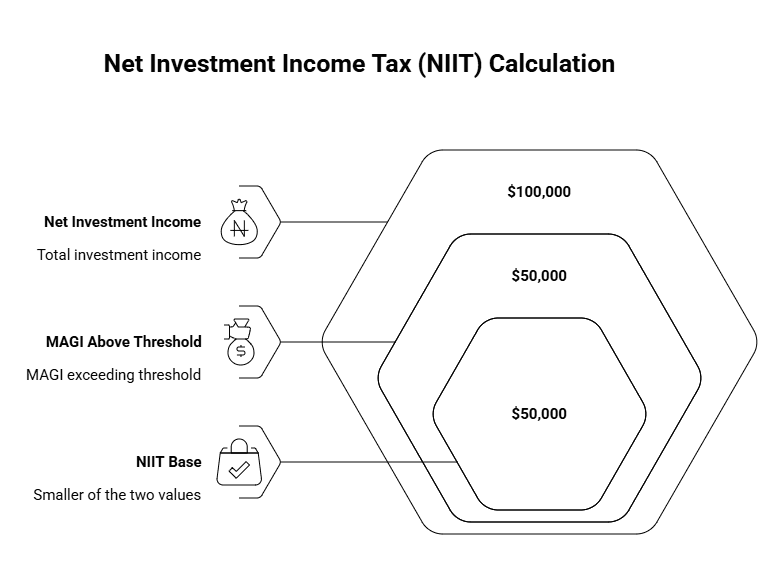
Step 3: Compute the NIIT Base
Calculate both:
Excess MAGI above threshold
Net investment income
NIIT applies to the smaller value × 3.8%.
Real-World Examples for Founders Using Form 8960
The Net Investment Income Tax is calculated on the lesser of net investment income or excess modified adjusted gross income (MAGI) above the applicable threshold. The examples below show how that limitation works in practice.
Example 1: Startup Founder with Capital Gains
Filing status: Married filing jointly
MAGI: $300,000
Net investment income: $80,000
NIIT threshold (MFJ): $250,000
Excess MAGI:
$300,000 − $250,000 = $50,000
Because NIIT applies to the lesser of net investment income ($80,000) or excess MAGI ($50,000), the taxable amount is $50,000.
NIIT owed:
$50,000 × 3.8% = $1,900
Example 2: E-Commerce Founder with Rental Income
Filing status: Single
MAGI: $210,000
Net investment income: $40,000
NIIT threshold (Single): $200,000
Excess MAGI:
$210,000 − $200,000 = $10,000
Here, excess MAGI ($10,000) is lower than net investment income ($40,000), so NIIT applies only to $10,000.
NIIT owed:
$10,000 × 3.8% = $380
Form 8960 Walkthrough: Key Lines Founders Should Know
Line(s) | What It Covers | Founder Tip |
1–6 | Types of investment income | Separate passive vs. active business income. |
7–8 | Deductions | Track investment-related expenses. |
9–10 | Net investment income | Determines NIIT base. |
13–17 | MAGI and thresholds | Forecast income before equity sales. |
18 | Final NIIT owed | Plan tax payments accordingly. |
Minimizing NIIT Exposure: Founder Strategies
Time equity events (e.g., stock sales) during lower-income years
Reclassify rental income by participating materially
Use investment deductions such as interest expense
Optimize business structure
Lower total tax burden with credits (e.g., see Haven’s Form 1120 guide)
Embedding Form 8960 Into Your Tax Workflow
Maintain clear bookkeeping, separating investment income
Forecast MAGI for timing financial events
Use startup-savvy advisors for compliance
Leverage tax automation tools
For a broader tax infrastructure, review Haven’s business tax services.
Why Founders Should Prioritize Form 8960 Understanding
As a founder, your tax strategy directly influences capital allocation, long-term planning, and liquidity. Understanding Form 8960 and its NIIT implications ensures you avoid costly surprises and maintain financial clarity.
To optimize your tax position and confidently navigate forms like Form 8960, consider partnering with Haven’s founder-focused bookkeeping and tax filing teams.
For founders steering the financial course of startups, agencies, or e-commerce ventures, understanding specialized tax forms like Form 8960 is essential for optimizing tax outcomes. This guide provides a founder-friendly breakdown of the Net Investment Income Tax (NIIT), explaining how to calculate it using Form 8960 and why it matters for your business and personal finances.
What is Form 8960 and Why Should Founders Care?
Form 8960 is the IRS form used to calculate the Net Investment Income Tax (NIIT), a 3.8% surtax applied to certain investment income for individuals, estates, and trusts that exceed specified income thresholds.
Why does this affect founders?
Many founders' personal incomes include dividends, interest, capital gains, rental income, or other passive incomes derived from investments and business activities. If your modified adjusted gross income (MAGI) surpasses the threshold, you may owe NIIT on your net investment income — impacting your after-tax wealth and reinvestment capacity.
Understanding Form 8960 enables founders to:
Accurately determine NIIT liability
Strategically manage investments to minimize tax burden
Align accounting and tax filings for compliance
Understanding Net Investment Income Tax on Form 8960
Form 8960 calculates NIIT based on two key concepts — your net investment income and whether your MAGI exceeds the applicable threshold.
Term | Definition | Implication for Founders |
Net Investment Income (NII) | Includes interest, dividends, capital gains, rental and royalty income, non-qualified annuities, passive business income, and other investment income. | Founders often receive these from stock sales, dividends, or rentals. |
Modified Adjusted Gross Income (MAGI) | AGI plus excluded foreign income. | NIIT applies when MAGI exceeds $200k (single) or $250k (married filing jointly). |
Calculating Net Investment Income Tax: Step-by-Step
Step 1: Calculate Your Net Investment Income
Add:
Taxable interest and dividends
Net capital gains (see our guide on capital gains recorded via Form 8949)
Rental and royalty income
Passive business income
Step 2: Determine If MAGI Exceeds the Threshold
$250,000 — Married Filing Jointly
$125,000 — Married Filing Separately
$200,000 — Single or Head of Household
Step 3: Compute the NIIT Base
Calculate both:
Excess MAGI above threshold
Net investment income
NIIT applies to the smaller value × 3.8%.
Real-World Examples for Founders Using Form 8960
The Net Investment Income Tax is calculated on the lesser of net investment income or excess modified adjusted gross income (MAGI) above the applicable threshold. The examples below show how that limitation works in practice.
Example 1: Startup Founder with Capital Gains
Filing status: Married filing jointly
MAGI: $300,000
Net investment income: $80,000
NIIT threshold (MFJ): $250,000
Excess MAGI:
$300,000 − $250,000 = $50,000
Because NIIT applies to the lesser of net investment income ($80,000) or excess MAGI ($50,000), the taxable amount is $50,000.
NIIT owed:
$50,000 × 3.8% = $1,900
Example 2: E-Commerce Founder with Rental Income
Filing status: Single
MAGI: $210,000
Net investment income: $40,000
NIIT threshold (Single): $200,000
Excess MAGI:
$210,000 − $200,000 = $10,000
Here, excess MAGI ($10,000) is lower than net investment income ($40,000), so NIIT applies only to $10,000.
NIIT owed:
$10,000 × 3.8% = $380
Form 8960 Walkthrough: Key Lines Founders Should Know
Line(s) | What It Covers | Founder Tip |
1–6 | Types of investment income | Separate passive vs. active business income. |
7–8 | Deductions | Track investment-related expenses. |
9–10 | Net investment income | Determines NIIT base. |
13–17 | MAGI and thresholds | Forecast income before equity sales. |
18 | Final NIIT owed | Plan tax payments accordingly. |
Minimizing NIIT Exposure: Founder Strategies
Time equity events (e.g., stock sales) during lower-income years
Reclassify rental income by participating materially
Use investment deductions such as interest expense
Optimize business structure
Lower total tax burden with credits (e.g., see Haven’s Form 1120 guide)
Embedding Form 8960 Into Your Tax Workflow
Maintain clear bookkeeping, separating investment income
Forecast MAGI for timing financial events
Use startup-savvy advisors for compliance
Leverage tax automation tools
For a broader tax infrastructure, review Haven’s business tax services.
Why Founders Should Prioritize Form 8960 Understanding
As a founder, your tax strategy directly influences capital allocation, long-term planning, and liquidity. Understanding Form 8960 and its NIIT implications ensures you avoid costly surprises and maintain financial clarity.
To optimize your tax position and confidently navigate forms like Form 8960, consider partnering with Haven’s founder-focused bookkeeping and tax filing teams.
This article was co-written by:
Content
This article was co-written by:
2026
© Haven All Rights Reserved
Haven is a financial technology company, not an FDIC-insured bank. Banking services are provided by OMB Bank, Member FDIC. Deposits in checking and savings accounts are held at OMB Bank and are insured by the FDIC up to the applicable limits. FDIC insurance covers the failure of an insured bank. Certain conditions must be met for pass-through insurance coverage to apply. Fees, terms, and conditions apply to depositing and using your account.
2026
© Haven All Rights Reserved
Haven is a financial technology company, not an FDIC-insured bank. Banking services are provided by OMB Bank, Member FDIC. Deposits in checking and savings accounts are held at OMB Bank and are insured by the FDIC up to the applicable limits. FDIC insurance covers the failure of an insured bank. Certain conditions must be met for pass-through insurance coverage to apply. Fees, terms, and conditions apply to depositing and using your account.
2026
© Haven All Rights Reserved
Haven is a financial technology company, not an FDIC-insured bank. Banking services are provided by OMB Bank, Member FDIC. Deposits in checking and savings accounts are held at OMB Bank and are insured by the FDIC up to the applicable limits. FDIC insurance covers the failure of an insured bank. Certain conditions must be met for pass-through insurance coverage to apply. Fees, terms, and conditions apply to depositing and using your account.